PPM to Water Hardness Calculator
Convert mineral concentration in PPM (as CaCO₃) to Grains Per Gallon (GPG)
1 GPG = 17.1 PPM (as CaCO₃)
GPG = PPM ÷ 17.1
Easy PPM to Water Hardness Calculator – Convert PPM to Hardness Levels
A simple calculator to convert PPM into water hardness categories: soft, moderate, hard, and very hard. Great for home testing and filter maintenance.
Have you ever noticed chalky white spots on your dishes, found that your soap doesn't lather well, or dealt with clogged showerheads? The culprit is likely "hard water." But what exactly is hard water, and how hard is your water? Our PPM to Water Hardness Calculator is designed to give you a precise answer.
This comprehensive guide will walk you through how to use the calculator, explain the science behind the calculations in simple terms, explore why knowing your water hardness is crucial, and answer the most frequently asked questions on the topic.
How to Use the PPM to Water Hardness Calculator
Our calculator is a simple yet powerful tool. It takes the concentration of the two primary minerals that cause hardness—calcium (Ca²⁺) and magnesium (Mg²⁺)—and converts them into a standard measurement of water hardness.
Here’s a step-by-step guide to get your results:
- Find Your Mineral Concentrations: First, you need to know the amount of calcium and magnesium in your water, measured in parts per million (ppm). This unit is equivalent to milligrams per liter (mg/L). You can typically find this information from your local water utility's annual quality report, or by using a home water testing kit.
- Enter the Calcium Value: In the first field, labeled "Calcium (Ca²⁺) in ppm (mg/L)," type in the concentration of calcium. For example, if your water report says you have 70 ppm of calcium, enter "70".
- Enter the Magnesium Value: In the second field, labeled "Magnesium (Mg²⁺) in ppm (mg/L)," type in the concentration of magnesium. For example, if your report shows 30 ppm, enter "30".
- Click Calculate: Hit the "Calculate" button.
- Review Your Results: The calculator will instantly provide you with three key pieces of information:
- Total Hardness (mg/L): This is the standard scientific measurement, equivalent to ppm.
- Total Hardness (gpg): This converts the hardness into Grains Per Gallon, a unit commonly used in the United States, especially for setting up water softeners.
- Classification: This tells you whether your water is considered Soft, Moderately Hard, Hard, or Very Hard, based on established standards. The visual indicator bar also gives you a quick look at where your water falls on the hardness spectrum.
Part of PPMCalculator.com — your source for accurate, fast, and easy-to-use chemistry and unit conversion tools.
The Science Behind the Scenes: Formula & Conversion Explained
You might be wondering what happens when you click that "Calculate" button. It’s not just simple addition; there's a specific scientific formula at work designed to create a standardized measurement. Let's break it down.
Why We Need a Standard: The CaCO₃ Equivalent
Water hardness is caused by dissolved divalent cations—ions with a +2 charge. While calcium (Ca²⁺) and magnesium (Mg²⁺) are the most common, others like iron (Fe²⁺) and manganese (Mn²⁺) can also contribute. To make sense of it all, scientists and water professionals measure hardness in terms of the "calcium carbonate equivalent" (CaCO₃).
Think of it like converting different currencies into a single one (like the U.S. dollar) for easy comparison. By expressing the hardness effect of both calcium and magnesium in terms of calcium carbonate, we get one consistent number. This is done because CaCO₃ has a molar mass of almost exactly 100 g/mol, making the math much cleaner.
The Water Hardness Formula
The calculator uses the following standard formula:
Total Hardness (as CaCO₃) in mg/L = (Calcium concentration in mg/L × 2.497) + (Magnesium concentration in mg/L × 4.118)
Let's look at those multipliers:
- Calcium (× 2.497): This number is derived from the ratio of the molar mass of calcium carbonate (100.09 g/mol) to the molar mass of calcium (40.08 g/mol). (100.09 / 40.08 ≈ 2.497).
- Magnesium (× 4.118): Similarly, this is the ratio of the molar mass of calcium carbonate (100.09 g/mol) to the molar mass of magnesium (24.31 g/mol). (100.09 / 24.31 ≈ 4.118).
This formula ensures that regardless of the mix of calcium and magnesium, the final result is a standardized value that accurately reflects the total hardness.
Converting PPM (mg/L) to GPG
While mg/L (or ppm) is the global standard, Grains Per Gallon (GPG) is very common in the U.S. plumbing and water treatment industry. The conversion is straightforward: 1 GPG = 17.1 mg/L (or 17.1 ppm)
So, to get the GPG value, the calculator simply divides the total hardness in mg/L by 17.1. This GPG number is often the exact value you need when programming a new water softener for your home.
Applications & Use Cases: Why Does Water Hardness Matter?
Knowing your water hardness isn't just for trivia night. It has practical, everyday implications for your home, hobbies, and even industrial processes.
- For Homeowners: This is the most common reason people use a PPM to Water Hardness Calculator. Hard water leaves limescale buildup on faucets, showerheads, and inside appliances like water heaters and dishwashers. This scale reduces efficiency, increases energy bills, and can lead to costly repairs. It also reacts with soap to form soap scum, meaning you use more soap and detergent, and it can leave your skin feeling dry and your hair looking dull.
- Aquariums and Fishkeeping: Different species of fish have evolved to thrive in specific water conditions. An African Cichlid, for example, needs hard, alkaline water, while a Discus or Neon Tetra requires very soft water. Using a hardness calculator helps aquarists create the perfect environment for their aquatic pets.
- Gardening and Agriculture: The mineral content in water can affect soil pH and the availability of nutrients to plants. Very hard water can lead to a buildup of salts in the soil over time, potentially harming sensitive plants.
- Coffee and Tea Brewing: The mineral profile of water significantly impacts flavor extraction. Baristas and coffee aficionados know that moderately hard water is often ideal for a balanced, flavorful cup. Water that is too soft can result in a flat, uninteresting taste, while water that is too hard can lead to over-extraction and bitterness.
- Beer Brewing: Brewers are meticulous about their water chemistry. The levels of calcium, magnesium, and other ions are critical for enzymatic activity during the mashing process and for the final taste and mouthfeel of the beer.
- Industrial Applications: In commercial settings like factories, hospitals, and hotels, hard water can cause massive problems in boilers, cooling towers, and other equipment. The scale buildup can lead to equipment failure, reduced efficiency, and significant operational costs.
Frequently Asked Questions (FAQs)
Here are answers to some of the most common questions about water hardness.
What exactly is water hardness?
Water hardness is a measure of the amount of dissolved minerals, primarily calcium and magnesium, in water. As rainwater passes through the ground, it dissolves these minerals from rock and soil. The more minerals it dissolves, the "harder" the water becomes. While not a health concern, this mineral content can cause the various nuisance issues described above.
What is the difference between PPM and GPG?
PPM (Parts Per Million) and GPG (Grains Per Gallon) are simply two different units for measuring the same thing—the concentration of hardness minerals in water. PPM, which is equivalent to mg/L, is a metric-based unit used widely in scientific contexts. GPG is an older unit based on the weight of a single grain of wheat and is still the standard in the U.S. water softening industry. The key conversion to remember is 1 GPG = 17.1 PPM.
Is hard water dangerous to my health?
No, hard water is not considered a health risk. In fact, the calcium and magnesium in hard water can be a minor contributor to your daily dietary intake of these essential minerals. The World Health Organization (WHO) has found no scientific evidence that drinking hard water is harmful to human health. Any issues associated with hard water are purely aesthetic or mechanical (related to plumbing and appliances).
How can I find the calcium and magnesium PPM for my water?
There are three common ways to get this information:
- Check Your Local Water Utility Report: Most municipal water suppliers are required to publish an annual water quality report (sometimes called a Consumer Confidence Report). This is often available on their website and will list the average levels of various minerals, including calcium and magnesium.
- Use a Home Test Kit: You can purchase water hardness test strips or more complex titration kits online or from home improvement stores. While test strips are easy to use, they are generally less precise than a digital test or a lab report.
- Professional Lab Testing: For the most accurate results, you can send a water sample to a certified laboratory for analysis. This is a great option if you have a private well or want a highly detailed breakdown of your water's chemistry.
What is considered a "hard" water level?
Water hardness is generally classified on a spectrum. While different organizations use slightly different scales, a commonly accepted classification is:
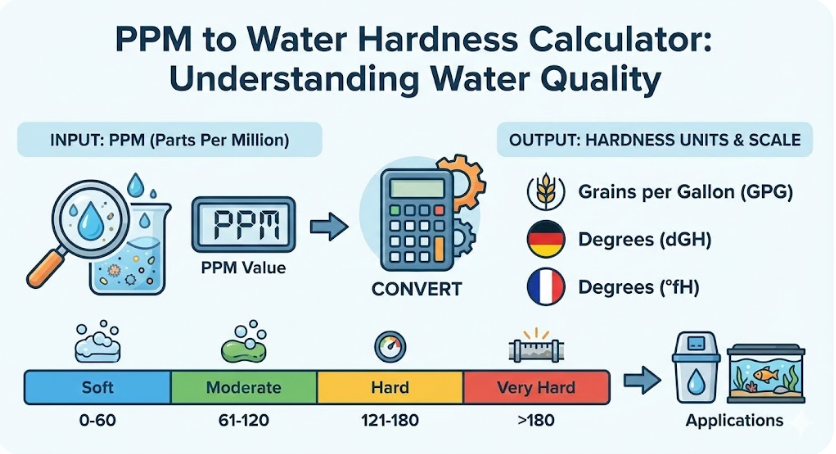
- Soft: 0–60 mg/L (0–3.5 GPG)
- Moderately Hard: 61–120 mg/L (3.5–7.0 GPG)
- Hard: 121–180 mg/L (7.0–10.5 GPG)
- Very Hard: Over 180 mg/L (Over 10.5 GPG)
Our calculator uses this scale to give you an instant classification of your water.
Does boiling water get rid of hardness?
Boiling can remove some types of hardness, but not all. Water hardness is broken into two types:
- Temporary Hardness (Carbonate Hardness): This is caused by calcium and magnesium bicarbonates. When you boil water, these compounds break down and precipitate out of the water as solid calcium carbonate—the limescale you see in your kettle.
- Permanent Hardness (Non-carbonate Hardness): This is caused by calcium and magnesium sulfates and chlorides. Boiling has no effect on these minerals.
Therefore, boiling can soften water with high temporary hardness, but it won't work for water with high permanent hardness. A water softener is needed to remove both types.
Related Calculators and Resources:
- Calcium Hardness Calculator — manage CaCO3 levels for pools and systems
https://ppmcalculator.com/calcium-hardness-calculator/ - Langelier Saturation Index (LSI) Calculator — assess scaling and corrosion risk
https://ppmcalculator.com/langelier-saturation-index-calculator/ - TDS to PPM Calculator — translate TDS readings into actionable ppm
https://ppmcalculator.com/tds-to-ppm-calculator/ - mg/L to PPM Calculator — quick unit conversion used in hardness reporting
https://ppmcalculator.com/mg-l-to-ppm-calculator/ - PPM Conversion Table — fast lookups across ppm, mg/L, %, and common hardness units
https://ppmcalculator.com/ppm-conversion-table/ - PPM vs TDS vs EC — understand how conductivity-based meters estimate hardness/ppm
https://ppmcalculator.com/ppm-vs-tds-vs-ec/ - How to Calculate PPM Step‑by‑Step — verify your ppm math with worked examples
https://ppmcalculator.com/how-to-calculate-ppm-step-by-step/ - PPM Formula Variations — when to use mass‑based vs. volume‑based formulas
https://ppmcalculator.com/ppm-formula-variations/ - PPM for Water Testing — methods, sampling, and QA/QC for reliable hardness data
https://ppmcalculator.com/ppm-for-water-testing/