PPM ⇄ PPT Conversion Calculator
Convert between PPM (10⁶), PPB (10⁹), and PPT (10¹²)
1 PPM = 1,000 PPB = 1,000,000 PPT
1 PPB = 1,000 PPT
1 PPT = 10⁻⁶ PPM
Parts Per Million to Parts Per Trillion Calculator – Accurate PPM → PPT Tool
Convert PPM values into PPT with laboratory precision. Perfect for scientists, analysts, water quality testing, chemical studies, and trace-level contaminant analysis.A simple tool that converts parts per million to parts per trillion. Great for students, teachers, and anyone dealing with chemical concentration scales.
Understanding the concentration of substances is crucial in many fields, from environmental science to chemistry and agriculture. Two of the most common units of measurement for these concentrations are parts per million (ppm) and parts per thousand (ppt). While these units are widely used, converting between them can sometimes be confusing.
Our PPM to PPT Conversion Calculator is designed to simplify this process, giving you an accurate result in just a few seconds. This guide will not only show you how to use the tool but also explain the science behind the conversion, its practical applications, and answer some of the most frequently asked questions.
How to Use the PPM to PPT Calculator
The PPM to PPT conversion calculator is an incredibly user-friendly tool. It’s designed for simplicity so you can get your results instantly without any complex steps.
- Enter Your Value: Locate the input field labeled “Enter value in PPM”. Click on this box and type in the numerical value of the concentration you want to convert. For example, if you’re measuring a substance at 5,000 ppm, you’ll simply type in
5000. - Click to Convert: Once your value is entered, press the “Convert to PPT” button. The calculator will perform the necessary calculation in the blink of an eye.
- View Your Result: A result box will appear below the button, showing you the converted value in ppt. The calculation is done instantly, saving you time and preventing potential errors.
The Science Behind the Conversion: Formula & Explanation
What Are PPM and PPT?
PPM and PPT are units used to measure the concentration of a substance, especially when that substance is present in very small amounts within a larger mixture or solution.
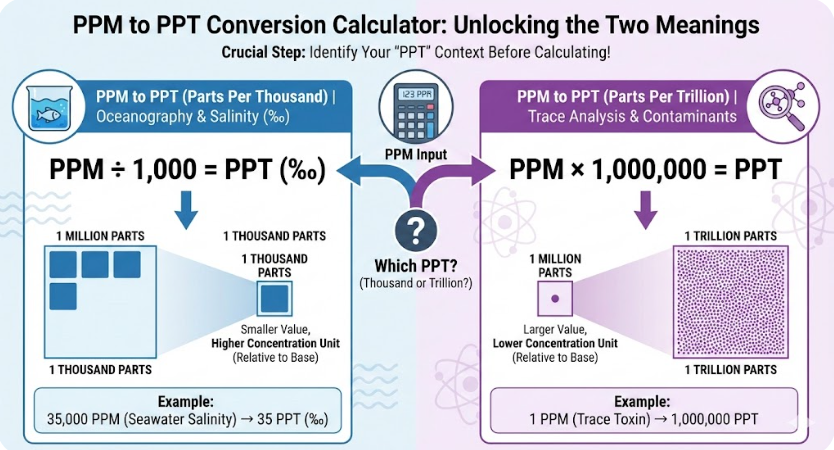
- PPM (Parts Per Million): This unit represents one part of a substance for every one million parts of the mixture. Think of it like dropping one tiny grain of salt into a million grains of sand. It’s often used for very low concentrations, such as pollutants in the air or trace minerals in water.
- PPT (Parts Per Thousand): This is a slightly larger unit. It represents one part of a substance for every one thousand parts of the mixture. A good way to visualize this is to imagine one teaspoon of sugar dissolved into one thousand teaspoons of water.
The Conversion Formula
The relationship between parts per million and parts per thousand is straightforward. Since a million is 1,000 times a thousand (1,000,000=1000×1000 ), you need to divide a ppm value by 1,000 to get the corresponding ppt value.
The formula is as follows: PPT=1000 / PPM
Example Conversion:
Let’s say you have a solution with a concentration of 25,000 ppm. To find its concentration in ppt, you would use the formula: PPT=1000 / 25000=25
So, a concentration of 25,000 ppm is equal to 25 ppt.
Practical Applications & Use Cases
The ability to convert between PPM to PPT is vital in a wide range of industries and scientific disciplines. Here are some of the most common applications:
Environmental Monitoring
Environmental scientists and engineers use these units to measure the concentration of pollutants in air and water. For example, they might measure the presence of nitrogen dioxide in the atmosphere in ppm and then convert it to ppt for a specific report or comparison. This is also critical for monitoring water quality in rivers and lakes.
Water and Chemical Solutions
In chemistry labs, solutions are often prepared and measured in ppm or ppt. A chemist might be working with a highly concentrated solution in ppt but need to dilute it and express the final concentration in ppm for a specific experiment. This conversion helps maintain accuracy and consistency across different lab procedures.
Agriculture and Hydroponics
In modern farming, especially hydroponics (growing plants without soil), growers must carefully control the nutrient solution fed to the plants.
The concentration of these nutrients is typically measured in ppm. However, if they need to prepare a larger batch of a different solution, they might need to use ppt as their reference unit. The conversion ensures the plants receive the exact required amount of nutrients.
Food and Beverage Industry
Quality control in the food industry relies on precise measurements. The concentration of additives, flavorings, or preservatives can be expressed in ppm. For higher concentrations, such as salt content in a pickle brine or sugar in a syrup, ppt is often the preferred unit. Converting between them helps with recipe development and consistent production.
Medical and Pharmaceutical Sciences
In medicine, concentrations of active ingredients in drugs or blood and urine test results are often expressed in parts per million. While typically these values are low enough to be in ppm, a conversion to ppt may be necessary for research, formulating specific compounds, or when dealing with higher-dose mixtures.
You’re using a tool from PPMCalculator.com, where we make chemistry and measurement calculations simple, accurate, and accessible for everyone.
Related Calculators and Resources
- EC to TDS/PPM Calculator
- TDS to PPM Calculator
- PPM Conversion Table
- PPM vs TDS vs EC
- How to Calculate PPM Step‑by‑Step
- PPM Accuracy Calculator
- PPM Solution Calculator
- PPM to Volume Calculator
- PPM to Weight Calculator
Frequently Asked Questions (FAQs)
What is the basic difference between PPM and PPT?
The main difference lies in their scale. PPM represents one part per million (1/1,000,000), while PPT represents one part per thousand (1/1,000). This means that PPT is a much larger unit of measurement for concentration, specifically 1,000 times greater than PPM.
When is it better to use PPM instead of PPT?
PPM is better for measuring very small or trace amounts of a substance. For example, the concentration of lead in drinking water or CO2 in the atmosphere is so low that expressing it in ppm is more practical. PPT is used for higher concentrations, such as the salinity of ocean water, which can be around 35 ppt.
Can I convert from PPT to PPM using the same logic?
Yes, you can! The conversion is simply reversed. To convert from PPT to PPM, you multiply the PPT value by 1,000. So, the formula would be: PPM=PPT×1000
Is PPM equivalent to milligrams per liter (mg/L)?
For dilute aqueous (water-based) solutions, yes, ppm is roughly equivalent to mg/L. This is because 1 liter of water has a mass of approximately 1 kilogram, and a milligram is one-thousandth of a gram, while a kilogram is 1,000 grams. Therefore, a milligram per kilogram is a millionth of a part, which is equivalent to one ppm. This equivalence is very useful in many applications, especially environmental science.
Why are these “parts-per” units used instead of percentages?
Percentages are typically used for more concentrated solutions. For example, a 1% solution means there is 1 part of the solute for every 100 parts of the solution. For trace amounts, a percentage would require multiple zeros after the decimal point (e.g., 0.0001%), which can be cumbersome and prone to error. PPM and PPT make these small values easier to read and work with.
How are PPM and PPT measured in real life?
These units are measured using specialized equipment called probes or sensors. For example, a salinity probe measures the salt content in water and displays the result in ppt. Similarly, an air quality monitor measures pollutants in ppm. In laboratories, advanced techniques like atomic absorption spectroscopy or mass spectrometry are used for very precise measurements.
Is PPM or PPT a “better” unit?
Neither unit is inherently “better.” The choice depends on the concentration of the substance you’re measuring. For very low concentrations, ppm is more appropriate, while for higher concentrations, ppt is a better choice. The goal is to use the unit that expresses the value most clearly and conveniently.