Accurately converting between PPM (parts per million), mg/L (milligrams per liter), percent (%), and PPB (parts per billion) is essential for laboratory work, water quality testing, environmental monitoring, and industry.
Below, you’ll find a comprehensive table, conversion formulas, step-by-step examples, and practical tips to help you make reliable conversions every time.
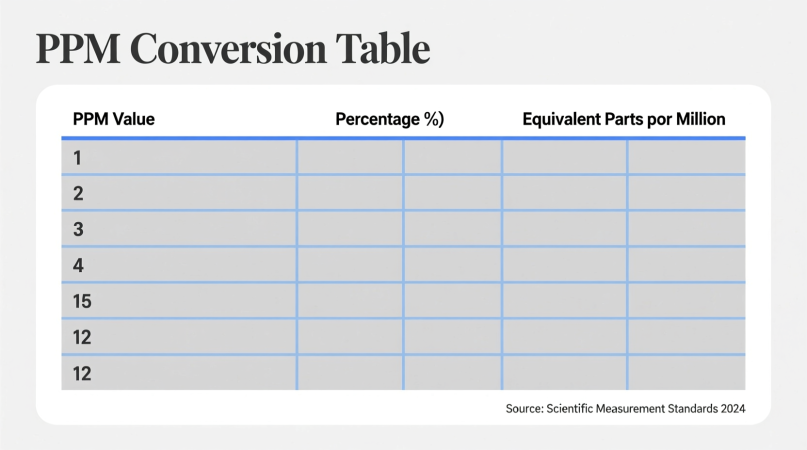
PPM Conversion Reference Table
| Unit | Relation to PPM | Conversion to PPM | Conversion from PPM | Example (100 ppm) |
|---|---|---|---|---|
| mg/L (water) | 1 mg/L = 1 ppm | ppm = mg/L | mg/L = ppm | 100 mg/L |
| % (percent) | 1% = 10,000 ppm | ppm = % × 10,000 | % = ppm ÷ 10,000 | 0.01% |
| ppb | 1 ppm = 1,000 ppb | ppm = ppb ÷ 1,000 | ppb = ppm × 1,000 | 100,000 ppb |
How to Use the Table
1. PPM and mg/L
- Rule: For dilute water solutions, 1 mg/L ≈ 1 ppm.
- Why: The density of water is roughly 1 kg/L, so 1 milligram of solute per liter of water means 1 part per million.
Formula:ppm = mg/Lmg/L = ppm
Example:
If your test shows 25 mg/L of nitrate in water, that’s 25 ppm nitrate.
2. PPM and Percent (%)
- Rule: 1% concentration is equal to 10,000 ppm.
- Why: Percentage is parts per hundred; ppm is parts per million. 1% = 1/100 = 10,000/1,000,000.
Formulas:
- To convert ppm to percent:
% = ppm ÷ 10,000 - To convert percent to ppm:
ppm = % × 10,000
Example:
- 50 ppm = 50 ÷ 10,000 = 0.005%
- 0.02% = 0.02 × 10,000 = 200 ppm
3. PPM and PPB
- Rule: 1 ppm = 1,000 ppb
- Why: A billion is 1,000 times greater than a million, so 1 ppm = 1,000 ppb.
Formulas:
- To convert ppm to ppb:
ppb = ppm × 1,000 - To convert ppb to ppm:
ppm = ppb ÷ 1,000
Example:
- 2 ppm = 2 × 1,000 = 2,000 ppb
- 25,000 ppb = 25,000 ÷ 1,000 = 25 ppm
More Practical Examples
Example 1: Converting mg/L to Percent
You measure 150 mg/L of calcium in your water. What is this as a percentage?
- Since 1 mg/L = 1 ppm (in water), 150 mg/L = 150 ppm
- Convert ppm to percent:
% = 150 ÷ 10,000 = 0.015%
Example 2: Converting Percent to PPB
A fertilizer label says it contains 0.003% iron.
- Convert percent to ppm:
ppm = 0.003 × 10,000 = 30 ppm - Convert ppm to ppb:
ppb = 30 × 1,000 = 30,000 ppb
Example 3: Converting PPB to mg/L
A lab detects 800 ppb of lead in water. What is this in mg/L?
- Convert ppb to ppm:
ppm = 800 ÷ 1,000 = 0.8 ppm - Since 1 ppm = 1 mg/L in water,
mg/L = 0.8 mg/L
Quick Conversion Formulas
- mg/L to ppm:
1 mg/L = 1 ppm(for water) - ppm to mg/L:
1 ppm = 1 mg/L(for water) - ppm to percent:
% = ppm ÷ 10,000 - percent to ppm:
ppm = % × 10,000 - ppm to ppb:
ppb = ppm × 1,000 - ppb to ppm:
ppm = ppb ÷ 1,000 - mg/L to ppb:
ppb = mg/L × 1,000(for water)
Important Notes and Tips
- Water Density: These conversions assume the density of water is ~1 kg/L (valid for most drinking water, not for very salty solutions or other liquids).
- Context Matters: For gases or solids, check if conversions need to be adjusted for temperature, pressure, or sample mass.
- Always Check Units: Before calculating, make sure your numbers are in the correct units (mg/L, ppm, etc.).
Useful Resources
Summary Table
| Convert from | Convert to | Multiply / Divide by | Formula Example |
|---|---|---|---|
| mg/L | ppm | — | 120 mg/L = 120 ppm |
| ppm | mg/L | — | 80 ppm = 80 mg/L |
| ppm | percent | ÷ 10,000 | 500 ppm = 0.05% |
| percent | ppm | × 10,000 | 0.02% = 200 ppm |
| ppm | ppb | × 1,000 | 2 ppm = 2,000 ppb |
| ppb | ppm | ÷ 1,000 | 10,000 ppb = 10 ppm |

Dr. Robert is an industrial chemist specializing in process control, water purification, and quantitative chemical analysis. She has worked with environmental labs and manufacturing facilities to optimize solutions in parts-per-million (PPM) precision and safety compliance.
At PPMCalculator.com, Dr. Robert ensures the accuracy of each calculator and guide through peer review and data validation. Her mission is to make chemistry tools more reliable for engineers, researchers, and students worldwide.
Follow her professional updates on LinkedIn or contact via info@ppmcalculator.com. For More details, Click here