How to Calculate PPM Step by Step
Calculating parts per million (PPM) is a fundamental skill in science, environmental monitoring, water quality testing, and many other fields. PPM helps quantify tiny concentrations of substances in liquids, gases, and solids. Whether you’re a student, technician, or hobbyist, this step-by-step guide will make PPM calculation straightforward and easy to understand.
Step 1: Understand the Basic Formula
The general formula for PPM is:
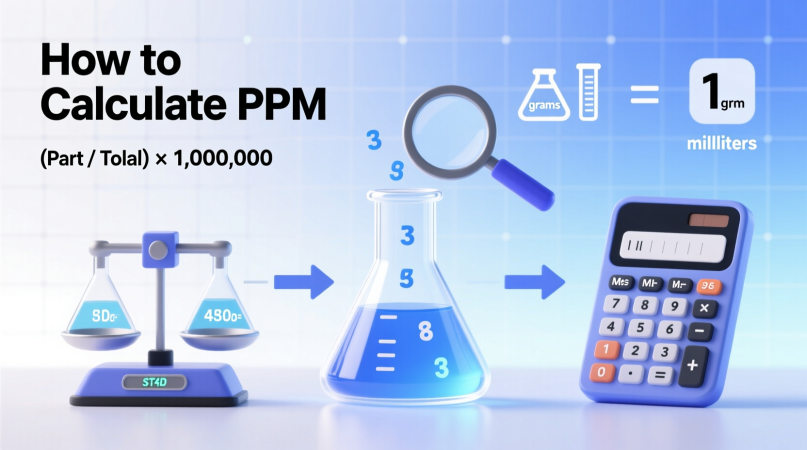
PPM = (Mass of solute / Mass of solution) × 1,000,000
For liquids, assuming the density is close to water, you can use volume instead of mass:
PPM = (mg of solute) / (L of solution)
Step 2: Gather Your Data
You need:
- The mass of the substance (in milligrams, mg)
- The volume of the solution (in liters, L)
If your measurements are in grams or milliliters, convert them first:
- 1 gram = 1,000 milligrams
- 1 milliliter = 0.001 liters
Step 3: Plug Values Into the Formula
Example 1: Calculating PPM in Water
You dissolve 10 mg of salt in 2 liters of water.
Using the formula:
PPM = 10 mg / 2 L = 5 ppm
So, the concentration is 5 ppm.
Example 2: Calculating PPM with Different Units
If you have 0.05 grams of solute in 500 milliliters of solution:
- Convert grams to milligrams:
0.05 g = 50 mg - Convert milliliters to liters:
500 mL = 0.5 L - Calculate PPM:
PPM = 50 mg / 0.5 L = 100 ppm
Step 4: Use Online Calculators for Convenience
To reduce errors and save time, use online tools like the PPM Solution Calculator. Just enter your mass and volume, and get instant, accurate results.
Step 5: Interpret Your PPM Result
Compare your calculated PPM to safety or regulatory limits. For example:
- Drinking water typically should have TDS below 500 ppm.
- Chlorine levels in pools are maintained between 1-3 ppm.
For detailed guidelines, see Safe PPM Levels for Drinking Water.
Tips for Accurate PPM Calculation
- Always double-check your units before calculating.
- Use precise measuring equipment.
- For non-aqueous solutions, adjust for density if necessary.
- Keep a record of your calculations for future reference.
Frequently Asked Questions
Q: Is 1 mg/L equal to 1 ppm?
A: Yes, for water and dilute aqueous solutions, 1 mg/L ≈ 1 ppm.
Q: Can I calculate PPM for gases?
A: Yes, but PPM in gases is often measured as volume per volume (v/v).
Q: What if I don’t know the volume?
A: You need the total volume (or mass) of your solution to calculate PPM accurately.

Dr. Robert is an industrial chemist specializing in process control, water purification, and quantitative chemical analysis. She has worked with environmental labs and manufacturing facilities to optimize solutions in parts-per-million (PPM) precision and safety compliance.
At PPMCalculator.com, Dr. Robert ensures the accuracy of each calculator and guide through peer review and data validation. Her mission is to make chemistry tools more reliable for engineers, researchers, and students worldwide.
Follow her professional updates on LinkedIn or contact via info@ppmcalculator.com. For More details, Click here