Water Quality PPM to NTU Calculator – Turbidity & Solids Estimator
Estimate NTU turbidity from PPM of suspended solids. Ideal for municipal water treatment, industrial filtration, wastewater testing, and environmental monitoring.
Understanding the relationship between PPM (parts per million) and NTU (Nephelometric Turbidity Units) is crucial for many industries, from water treatment to environmental monitoring.
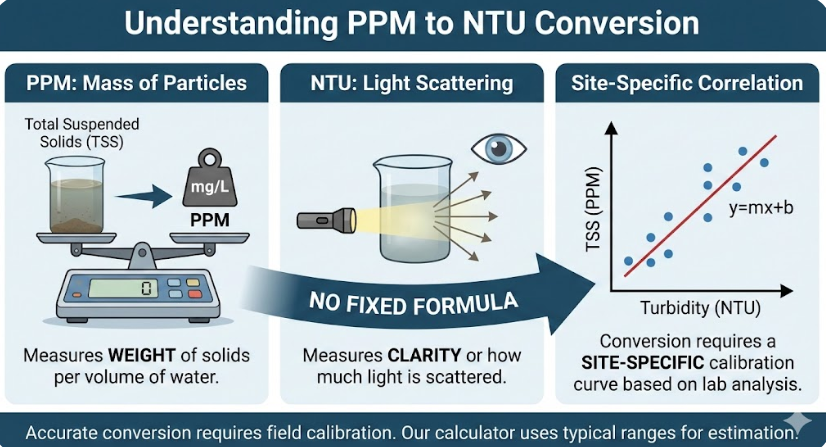
While they both measure water quality, they are fundamentally different metrics and cannot be converted with a single, universal formula. This guide will walk you through what these terms mean, how to use our custom calculator, and answer some of the most common questions on the topic.
What are PPM and NTU?
Before we dive into the calculator, let’s clarify what each unit represents.
PPM (Parts Per Million): This is a unit of concentration, expressing the amount of a substance in a million parts of a solution. In the context of water, it’s often used interchangeably with mg/L (milligrams per liter), since one liter of water weighs approximately one million milligrams. PPM is a measure of the mass of a solute dissolved in a solution. For example, a sugar solution with a concentration of 50 PPM means there are 50 milligrams of sugar in every liter of the solution.
NTU (Nephelometric Turbidity Units): This is a measure of turbidity, which is the cloudiness or haziness of a fluid. Turbidity is caused by suspended particles that are too small to be seen individually but are large enough to scatter light. An NTU measurement is based on how much light is scattered at a 90-degree angle by these particles. The more light that is scattered, the higher the NTU value, indicating a higher level of turbidity.
The key takeaway is that PPM measures concentration (mass), while NTU measures an optical property (light scattering). This is why a simple, direct conversion is not possible.
How to Use the PPM to NTU Conversion Calculator
Since there is no universal conversion, our calculator works by letting you set a specific conversion factor that is relevant to your specific application. This factor is typically determined through lab testing, where you measure both the PPM and NTU of your particular fluid and its suspended solids.
Follow these simple steps to use the calculator:
Find Your Conversion Factor: This is the most critical step. Based on lab analysis of your specific fluid and the type of suspended particles you are working with, determine the correlation between PPM and NTU. For example, if you find that 100 PPM of your substance corresponds to 300 NTU, your conversion factor would be 3 (since 300/100=3). A common starting point for many applications is a factor of 3, as it is a widely accepted rough estimate for certain materials.
Enter the Factor: Input your determined conversion factor into the “Conversion Factor” box. The default value is 3.0, but you can change it to whatever works for your needs.
Enter a Value: To perform a conversion, enter a value into either the “PPM” or “NTU” field.
Click “Calculate”: Once you’ve entered the values, simply click the “Calculate” button.
View the Result: The converted value and a clear explanation of the calculation will appear in the result box below.
Our calculator provides the flexibility to perform conversions in either direction: from PPM to NTU or from NTU to PPM, based on the value you enter.
Formula and Conversion Explanation
The calculator uses a straightforward formula once a conversion factor is established.
To Convert PPM to NTU: NTU=PPM×Conversion Factor
To Convert NTU to PPM: PPM=NTU/Conversion Factor
Let’s use an example. If your conversion factor is 3, and you want to convert 50 PPM: NTU=50×3=150
The result is 150 NTU.
If you have a reading of 210 NTU and a factor of 3, you can convert it to PPM: PPM=210/3=70
The result is 70 PPM.
This tool is designed to provide an approximate conversion for your specific conditions, not an absolute scientific rule.
Applications and Use Cases of PPM & NTU
Understanding both PPM and NTU is vital in various fields, as they provide different insights into water quality.
Drinking Water and Wastewater Treatment: Turbidity (NTU) is a key indicator of water quality in drinking water and wastewater treatment plants. High turbidity can protect disease-causing microorganisms from disinfection, so keeping NTU low is crucial for public health. PPM, on the other hand, is used to measure the concentration of disinfectants like chlorine or the level of contaminants.
Environmental Monitoring: Scientists use NTU to assess the clarity of natural water bodies like lakes and rivers. High turbidity can indicate erosion, pollution, or the presence of suspended algae, all of which can harm aquatic ecosystems. PPM is used to measure the concentration of specific pollutants like heavy metals or chemicals.
Industrial Processes: In manufacturing and industrial processes, controlling fluid quality is essential. NTU is used to monitor processes like filtration and clarification, while PPM is used to maintain the correct concentration of chemicals or product ingredients.
Aquaculture: For fish farms and aquariums, maintaining a stable environment is crucial. Monitoring NTU helps ensure the water is clear enough for fish to thrive, while PPM is used to control the concentration of nutrients, medications, or other additives.
FAQs about PPM to NTU Conversion
1. Why can’t I use a standard formula for PPM to NTU conversion?
As we’ve explained, PPM measures the mass concentration of suspended solids, while NTU measures the amount of light scattered by those particles. The amount of light scattering is not solely dependent on the mass of particles, but also on their size, shape, color, and reflective properties. A small number of large, reflective particles might cause the same NTU reading as a large number of small, non-reflective ones, even if their total mass (PPM) is different.
2. Is 1 PPM always equal to 3 NTU?
No, the value of 3 NTU per 1 PPM is a common rule of thumb for certain types of suspended solids, particularly in wastewater. However, it is an approximation and can vary significantly depending on the specific characteristics of the water sample. Always determine a specific conversion factor for your application through direct measurement.
3. What is the difference between PPM and mg/L?
For water and dilute aqueous solutions, PPM is equivalent to mg/L. This is because one liter of water has a mass of approximately one million milligrams (1 kg). Thus, a concentration of one milligram per liter is one part per million by mass.
4. What are some other units for turbidity?
Besides NTU, other common units for turbidity include FNU (Formazin Nephelometric Units) and JTU (Jackson Turbidity Units). NTU is the most widely used standard in the United States, while FNU is more common in Europe.
5. Can turbidity affect water safety?
Yes, absolutely. High turbidity in drinking water is a serious concern. The suspended particles that cause turbidity can shield disease-causing microorganisms like bacteria and viruses from the effects of disinfectants like chlorine, making the water unsafe to drink. For this reason, water quality standards often require very low NTU levels.
6. How do I accurately determine the conversion factor for my specific water?
The best way to determine your specific conversion factor is through a process called site-specific calibration. This involves collecting a series of water samples and measuring both the total suspended solids (TSS) in mg/L (which is equivalent to PPM) using a laboratory gravimetric method, and the turbidity in NTU using a turbidimeter. By plotting these data points, you can establish a linear relationship and a reliable conversion factor for your location and the type of particles present.
7. Why is my turbidimeter reading high, but my PPM is low?
This can happen if the suspended particles in your water are very effective at scattering light. For example, very fine, colloidal particles may have a low mass (low PPM) but present a large surface area for light to scatter, resulting in a high NTU reading. Conversely, heavier, less-reflective particles might have a high mass (high PPM) but a lower NTU reading.
This guide and the accompanying calculator are designed to empower you with the knowledge and tools to handle PPM to NTU conversions effectively. We hope this resource proves to be a valuable asset for your work.