How to Use a PPM Calculator for Chemistry
Precision is everything in chemistry—especially when measuring concentrations as low as one part per million (ppm). Whether you’re preparing solutions in the lab, teaching students, or conducting research, a PPM calculator can save time, reduce errors, and ensure accuracy.
Why Chemists Use PPM Calculators
PPM (parts per million) is a common unit for expressing very low concentrations of solutes in solutions. In chemistry labs, you’ll often encounter PPM when measuring trace metals, contaminants, or preparing precise dilutions for experiments. For aqueous solutions, 1 ppm is typically equivalent to 1 mg of solute per liter of solution (1 mg/L), but always check the context and density if accuracy is critical.
For a refresher on the basics, see What is PPM?.
Benefits of Using a PPM Calculator
- Saves time compared to manual calculations
- Reduces human error in complex conversions
- Supports multiple units (mg/L, g/L, molarity, etc.)
- Ideal for lab work, classroom demonstrations, and research protocols
If you’re seeking best practices for accurate lab measurements, see PPM Best Practices for Lab Work.
Step-by-Step: Using a PPM Calculator in Chemistry
Step 1: Gather Your Information
Before you begin, have these details ready:
- The mass of your solute (in mg or g)
- The volume of your solution (in liters)
- If needed, the molar mass of the solute (for molarity calculations)
Step 2: Choose the Appropriate Calculator
Depending on your needs, select a calculator from the full calculator suite such as:
- PPM Solution Calculator (for mg/L and ppm conversions)
- Molarity Calculator
- PPM to Grams Calculator
Step 3: Enter Your Values
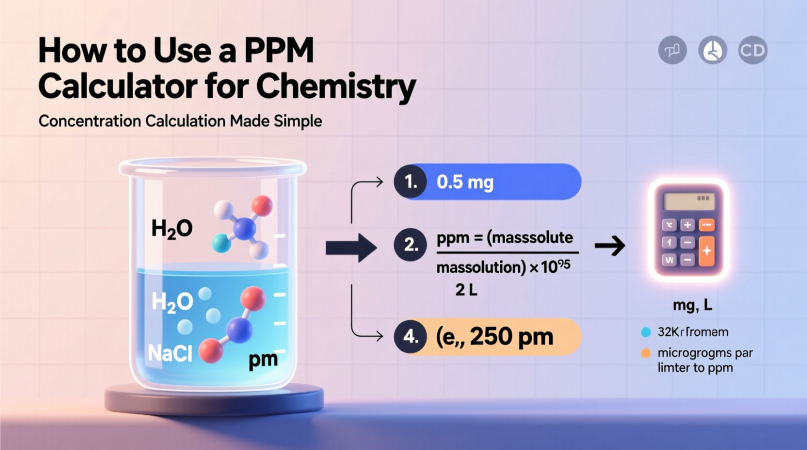
Let’s say you want to find the ppm of a solution containing 0.025 g of solute in 500 mL of water.
- Convert grams to milligrams:
0.025 g = 25 mg - Convert volume to liters:
500 mL = 0.5 L - Input these values into the calculator.
Manual Calculation Example
You can also use the standard formula:
PPM = (mg of solute) / (L of solution)
So,
PPM = 25 mg / 0.5 L = 50 ppm
Step 4: Interpret and Use Your Results
Once you have your ppm value, you can:
- Compare it to safety or experimental thresholds
- Prepare further dilutions
- Record for lab reports or compliance
For more detailed conversions, see Convert PPM to Concentration Units.
Advanced Tips for Chemists
Preparing Standard Solutions
If you need to make a solution at a certain ppm, use the PPM Solution Calculator to determine how much solute to weigh and dissolve in a specific volume.
Converting Between Units
Chemistry often demands conversion between ppm, mg/L, molarity, and percent. The PPM Conversion Table is a handy reference for these tasks.
Common Mistakes to Avoid
- Mixing up mg and g, or mL and L—always convert before entering values.
- Neglecting to calibrate lab equipment, which can skew results.
- Not accounting for solution density in highly concentrated or non-aqueous solutions.
For more, see PPM Calculation Mistakes.
Frequently Asked Questions
Can I use a PPM calculator for all types of solutions?
PPM calculators work best for dilute aqueous solutions. For other media, double-check if density corrections are needed. For more, see PPM Formula Variations.
How do I convert between ppm and molarity?
Use the formula:Molarity (mol/L) = (PPM × 10^-3) / Molar Mass (g/mol)
Or simply use the Molarity Calculator.
Where can I find more worked examples?
Visit PPM Calculation Examples for step-by-step cases.
Conclusion
Using a PPM calculator streamlines chemistry work, offering fast, precise, and reliable solutions—whether you’re in the classroom or the laboratory. By following these steps and making use of trusted tools from ppm calculator, you’ll ensure your measurements are always accurate and your results are scientifically sound.

Dr. Robert is an industrial chemist specializing in process control, water purification, and quantitative chemical analysis. She has worked with environmental labs and manufacturing facilities to optimize solutions in parts-per-million (PPM) precision and safety compliance.
At PPMCalculator.com, Dr. Robert ensures the accuracy of each calculator and guide through peer review and data validation. Her mission is to make chemistry tools more reliable for engineers, researchers, and students worldwide.
Follow her professional updates on LinkedIn or contact via info@ppmcalculator.com. For More details, Click here