Learn how to convert 10,000 ppm to percent (1%) with an easy formula and real-world examples. Understand ppm meaning in water testing, fertilizers, and chemistry on PPMCalculator.
Understanding 10,000 PPM
When you see 10,000 ppm, it stands for 10,000 parts per million — a precise unit expressing how much of one substance exists in one million parts of another.
This measurement is widely used in chemistry, agriculture, water testing, and manufacturing to express low concentrations where using a percentage would be cumbersome.
However, ppm and percent describe the same concept on different scales — ppm is just a smaller, more detailed way to say “part of a whole.”
How to Convert 10,000 PPM to Percent
The basic rule to remember is:
1 ppm=0.0001%
So to convert 10,000 ppm to percent:
10,000×0.0001=1%
✅ Answer: 10,000 ppm = 1%
That means the solute makes up 1 percent of the total solution.
This conversion is especially useful when adjusting concentration levels in fertilizers, disinfectant solutions, or industrial chemicals.
If you prefer automation, use the PPM to Percent Calculator to get instant, accurate results.
Formula for Converting PPM to Percent
The conversion formula is simple:
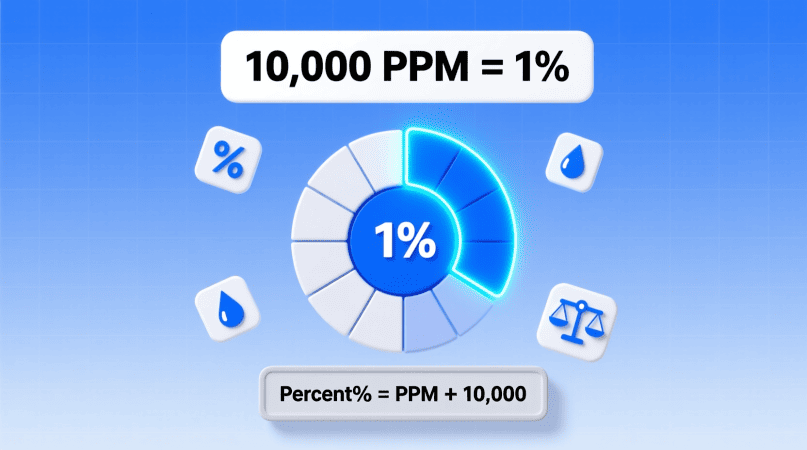
Percent=PPM/10,000
So for 10,000 ppm: 10,000÷10,000=1%
And if you want to go the other way: PPM=Percent×10,000
So, 1% = 10,000 ppm — they are two ways of expressing the same concentration.
You can verify other related conversions in the PPM Conversion Table.
Where 10,000 PPM Is Commonly Found
1. In Water and Pool Testing
A solution containing 10,000 ppm of total dissolved solids equals 1% impurity.
For pool salt systems, this can represent mid-range salinity. Use the Salt Pool PPM Calculator to check recommended values.
2. In Agriculture and Nutrients
In hydroponics or soil feeding, 10,000 ppm of a nutrient mix means 1% concentration — a common ratio for stock or concentrated nutrient solutions.
You can refine ratios with the Nutrient PPM Calculator.
3. In Chemistry Labs
Chemists often prepare 1% (10,000 ppm) solutions for titrations or calibration. For precise mixing, use the PPM Solution Calculator.
4. In Manufacturing and Quality Control
In product purity checks, 10,000 ppm contamination = 1% impurity. The PPM Accuracy Calculator helps ensure process tolerances remain within safe limits.
Why 10,000 PPM Equals 1% Is Important
Understanding ppm-to-percent conversions helps eliminate confusion across units used in reports, lab results, or equipment readings.
For instance, a chlorine reading of 10,000 ppm equals 1% chlorine solution, often used in sanitation or industrial cleaning — quite strong compared to typical pool levels of 2–5 ppm.
Mastering these conversions ensures precision and safety in both lab and field applications.
For a deeper explanation of ppm and its uses, see What Is PPM? and How to Calculate PPM in Chemistry.
Common Conversion Mistakes
- Dividing by 1000 instead of 10,000 — which produces 10% instead of 1%.
- Mixing up mg/L and ppm — they’re identical in water but not for gases or solids.
- Rounding too early — ppm conversions benefit from at least four decimal places.
Summary
10,000 ppm equals 1%.
That’s one part of solute per hundred parts of total solution, or ten thousand per million — both mean the same thing.
For quick conversions, step-by-step calculators, and practical examples, visit PPMCalculator — your trusted resource for ppm, percent, and solution concentration calculations.
Matthew is a chemical technology enthusiast and the creator of PPMCalculator.com — a platform dedicated to simplifying complex concentration and conversion formulas for students, researchers, and industry professionals. With years of experience exploring water chemistry, environmental monitoring, and laboratory analysis, he focuses on making scientific accuracy both practical and accessible.
When not writing or developing new tools, Shimul enjoys testing real-world chemical measurements, refining calculator algorithms, and helping learners understand the science behind PPM, EC, and TDS.