Learn how to convert 1000 ppm to percent (0.1%) with simple formulas, examples, and real-life applications. Explore how ppm relates to concentration, water testing, and lab accuracy at PPM Calculator.
Understanding What 1000 PPM Means
When you see 1000 ppm (parts per million), it refers to a ratio — one part of a substance in one million parts of solution. It’s a common unit used in chemistry, water testing, agriculture, and manufacturing.
To understand it better, ppm can easily be expressed as a percentage:
1 ppm=0.0001%
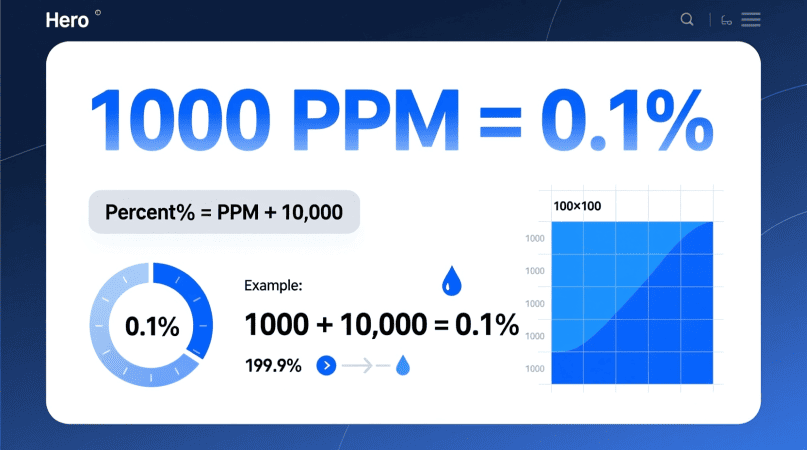
So, 1000 ppm=1000×0.0001=0.1%
That means 1000 ppm equals 0.1 percent concentration. This ratio is the same whether you’re talking about a nutrient solution, chlorine in pool water, or impurity levels in production.
How to Convert 1000 PPM to Percentage
The formula for converting ppm to percent is:
Percentage= PPM/10,000
Plugging in the numbers: 1000÷10,000=0.1%
It’s that simple. You can also use the PPM to Percent Calculator to make this conversion instantly, especially when dealing with values in the thousands or decimals.
Real-World Examples of 1000 PPM
- In water treatment: 1000 ppm of dissolved solids means 0.1% concentration — an important value in TDS to PPM conversion.
- In pool maintenance: Chlorine levels are often measured in ppm. A reading of 1000 ppm chlorine equals 0.1%, which would be too high for swimming pools. You can verify ideal levels using the Chlorine PPM Calculator.
- In fertilizer solutions: For growers, 1000 ppm of nitrogen or potassium represents 0.1% nutrient concentration. The NPK PPM Calculator helps balance nutrients precisely.
- In manufacturing or lab settings: 1000 ppm of a chemical impurity equals 0.1% contamination — data often used in quality and defect analysis with the PPM Accuracy Calculator.
Why Converting PPM to Percent Matters
PPM is great for expressing very low concentrations, but when numbers rise above a few thousand, switching to percentages makes interpretation simpler. For instance, a reading of 10,000 ppm equals 1%, which is easier to understand and communicate.
Knowing how to convert ppm to percent also helps when comparing reports from labs or digital meters that may use different units.
If you’re ever unsure, check your numbers with the PPM Solution Calculator — it provides accurate conversions and guides you through custom input values.
Common Mistakes to Avoid
- Confusing ppm with mg/L: While they’re often similar in water solutions, they differ in gases or solids.
- Forgetting to divide by 10,000: A common error that results in incorrect percentages.
- Rounding too early: Always keep at least two decimal places for accuracy.
You can explore more conversion help and examples in the PPM Conversion Table section.
Bottom Line:
1000 ppm = 0.1%, and that simple relationship can make a big difference in chemistry labs, water analysis, and nutrient dosing.
For quick and precise results, visit PPM Calculator — your all-in-one tool for ppm, percent, TDS, and solution conversions.
Matthew is a chemical technology enthusiast and the creator of PPMCalculator.com — a platform dedicated to simplifying complex concentration and conversion formulas for students, researchers, and industry professionals. With years of experience exploring water chemistry, environmental monitoring, and laboratory analysis, he focuses on making scientific accuracy both practical and accessible.
When not writing or developing new tools, Shimul enjoys testing real-world chemical measurements, refining calculator algorithms, and helping learners understand the science behind PPM, EC, and TDS.