Many students and lab professionals wonder: “How do you calculate ppm in chemistry?”
It’s one of the most common questions in analytical science, especially when dealing with solutions that contain very small amounts of a substance. Calculating ppm (parts per million) helps chemists describe how much solute is present in a solution with clarity and precision.
Whether you’re preparing a reagent, checking the purity of water, or analyzing environmental samples, understanding ppm will make your results more consistent and trustworthy.
What Does PPM Mean in Chemistry?
PPM stands for parts per million. It’s a way to express very dilute concentrations of one substance in another — for example, how many milligrams of a chemical exist per liter of water.
1 ppm means one part solute per one million parts of solution. In water-based chemistry, this is approximately 1 milligram per liter (mg/L).
Chemists use ppm when measuring trace metals, contaminants, nutrients, or dissolved substances that are too small to express in percentages.
If you’re new to the term, check our PPM Glossary for a clear breakdown of related concepts like TDS, EC, and ppb.
The Basic Formula to Calculate PPM
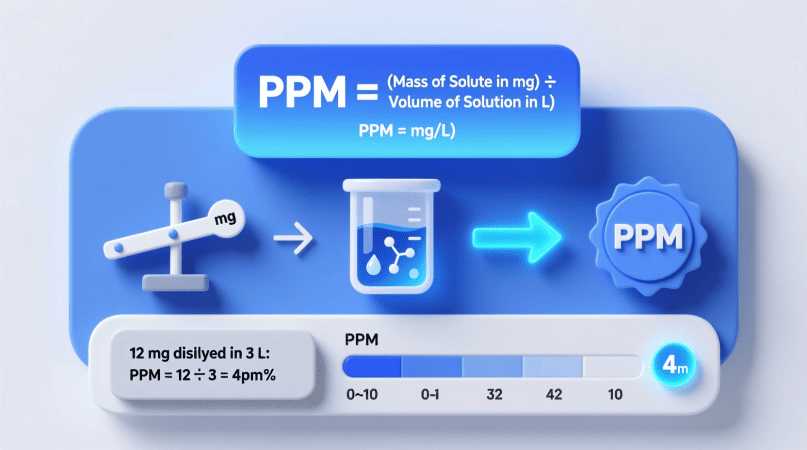
The general formula to calculate ppm in chemistry is simple:
PPM = Mass of Solute (mg) / Mass of Solution (kg)
Since the density of water is close to 1 kg per liter, it’s common to express the formula as:
PPM= mg of Solute / L of Solution
That means if you dissolve 1 mg of any substance in 1 liter of water, the concentration is 1 ppm.
This ratio is widely used across laboratories because it allows scientists to compare concentration levels, regardless of what substance or solvent they’re working with. You can find more formula variations in our PPM Formula Variations guide.
Step-by-Step Example: Calculating PPM of a Salt Solution
Let’s say you dissolve 8 mg of sodium chloride (NaCl) into 4 liters of distilled water.
To find the ppm:
- Write down the formula:
PPM= mg solute / L solution - Plug in your values:
PPM = 8/4 = 2 - The result: 2 ppm
That means there are 2 parts of NaCl per million parts of water.
If you want to double-check your math instantly, try our PPM Solution Calculator. It uses the same formula and automatically handles decimal conversions, saving you from manual errors.
Converting PPM to Other Units in Chemistry
In chemistry labs, ppm values often need to be converted into percent concentration, molarity, or mg/L, depending on the experiment or the chemical property being tested.
Here are the most common conversions:
- PPM to Percent:
Percent = PPM/10,000
For instance, 50 ppm = 0.005%.
Use our PPM to Percent Calculator for instant conversions.
- PPM to Molarity:
You’ll need the molar mass of the substance. The relationship is:
Molarity = PPM/Molar Mass*1000
Instead of doing this manually, the Molarity Calculator handles the conversion for you.
These conversions are vital when preparing solutions, calibrating instruments, or comparing different units of concentration across experiments.
PPM in Water Chemistry
In water chemistry, ppm is used for measuring dissolved minerals, metals, chlorine, and nutrients.
For instance:
- Chlorine levels in swimming pools are typically kept between 1 – 3 ppm.
- Iron content in drinking water should remain below 0.3 ppm for taste and safety.
If your field involves hydroponics, environmental monitoring, or industrial testing, ppm calculations are central to maintaining consistent quality. You can explore applications in our Environmental Monitoring Using PPM article.
Common Mistakes When Calculating PPM
Even experienced lab professionals make small errors that affect accuracy. Here are the most frequent mistakes:
- Using wrong units: Always convert grams to milligrams before using the ppm formula.
- Forgetting density: The assumption that 1 L = 1 kg is true for water but not for all solutions.
- Ignoring temperature: Density and solubility change with temperature, slightly affecting ppm results.
- Rounding too early: Keep full decimals during calculations and round at the end for precision.
For a full list of errors and how to fix them, see PPM Calculation Mistakes.
How PPM Relates to Chemistry Concepts
PPM connects deeply with chemical molarity, mass concentration, and stoichiometry.
When chemists analyze substances such as dissolved oxygen, trace heavy metals, or nutrient concentrations, ppm provides a universal scale that’s independent of molecular weight.
It’s also used in:
- Environmental testing: Detecting pollutants in air or water.
- Food chemistry: Measuring additives or residues.
- Pharmaceuticals: Ensuring correct dosages in liquid formulations.
Because ppm is a ratio, it gives a standardized language across different fields of chemistry.
Quick Reference Table
| Situation | Formula | Example Result |
|---|---|---|
| Basic solution | mg solute ÷ L solution | 5 mg NaCl ÷ 1 L = 5 ppm |
| Convert ppm to % | ppm ÷ 10,000 | 100 ppm = 0.01% |
| Convert ppm to molarity | ppm ÷ (molar mass × 1000) | 100 ppm NaCl = 0.0017 M |
| Convert mg/L to ppm | Equal value in water | 1 mg/L = 1 ppm |
Final Thoughts
Calculating ppm in chemistry doesn’t require complex math — just a clear understanding of ratios and units. Once you learn the basic formula, you can apply it to any solution, from environmental samples to lab reagents.
Remember:
- 1 mg per liter = 1 ppm.
- Double-check units and density for accuracy.
- Use calculators to save time and avoid manual errors.
If you’re doing this regularly, bookmark our PPM Solution Calculator or Molarity Calculator. They’re free, fast, and precise — ideal for chemists, students, and researchers who want reliable ppm results every time.
Matthew is a chemical technology enthusiast and the creator of PPMCalculator.com — a platform dedicated to simplifying complex concentration and conversion formulas for students, researchers, and industry professionals. With years of experience exploring water chemistry, environmental monitoring, and laboratory analysis, he focuses on making scientific accuracy both practical and accessible.
When not writing or developing new tools, Shimul enjoys testing real-world chemical measurements, refining calculator algorithms, and helping learners understand the science behind PPM, EC, and TDS.