Learn how to convert ppm to percent by weight (ppm ÷ 10,000) with examples and simple formulas. Understand ppm meaning in chemistry, water, and fertilizers. Explore practical guides on PPMCalculator.
What Does PPM to Percent by Weight Mean?
When you see a concentration written as ppm (parts per million), it describes the amount of one substance present per million parts of another.
When expressed by weight, ppm tells us how many grams of solute are present in one million grams of total solution.
For example, if a fertilizer solution contains 500 ppm of nitrogen, that means 500 grams of nitrogen per one million grams of total mixture. Converting this to percent by weight makes it easier to interpret on a more familiar scale.
The Formula for Converting PPM to Percent by Weight
The conversion between ppm and percent by weight is straightforward:
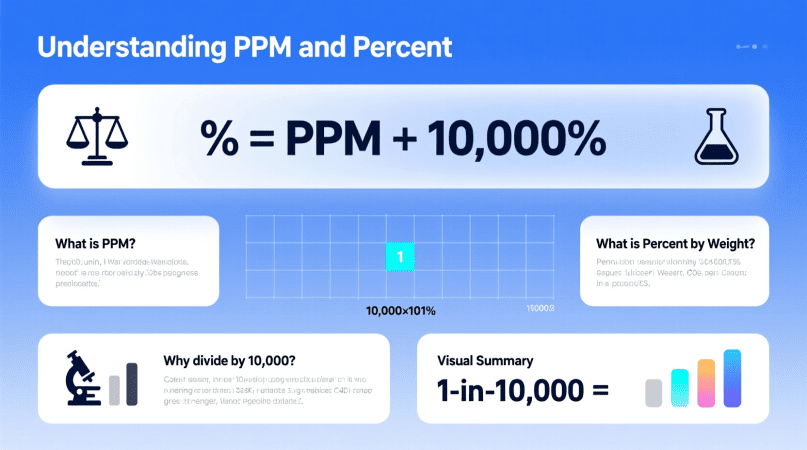
Percent by weight=PPM / 10,000
Each 1 ppm equals 0.0001% by weight, because there are 10,000 hundreds in one million.
So:
- 1 ppm = 0.0001% by weight
- 100 ppm = 0.01%
- 500 ppm = 0.05%
- 10,000 ppm = 1%
To go the other way: PPM=Percent by weight×10,000
How to Apply the Formula — Step-by-Step Example
Let’s say your lab report shows 2,000 ppm sodium chloride (NaCl) in a sample.
To find the concentration in percent by weight:
2,000÷10,000=0.2%
✅ Answer: 2,000 ppm = 0.2% by weight
That means 0.2% of the total sample mass is made up of sodium chloride.
If you prefer an automated approach, tools like the PPM Solution Calculator handle ppm-to-percent conversions for any solute or liquid.
Why Converting PPM to Percent by Weight Matters
This conversion is essential across multiple scientific and industrial fields:
- Water Testing: Measuring dissolved solids, chlorine, or metals in water. See how ppm levels translate using the TDS to PPM Calculator.
- Agriculture: Mixing fertilizers accurately requires knowing ppm-to-percent relationships. The Nutrient PPM Calculator ensures precise nutrient dosing.
- Chemical Manufacturing: Quality control labs often express impurities as ppm by weight — 10,000 ppm equals 1% impurity.
- Pool Maintenance: Chlorine or salt concentrations can be compared across units with the Chlorine PPM Calculator.
By converting ppm to percent by weight, results become easier to understand and communicate across different measurement systems.
Common Mistakes in PPM Conversions
- Dividing by 1,000 instead of 10,000, which overstates the percentage by 10×.
- Ignoring the “by weight” basis — ppm can also be by volume (gases) or molar, so always confirm the unit type.
- Rounding too early, which leads to significant errors in low concentrations.
For accuracy, reference values in the PPM Conversion Table or run precise calculations with the PPMCalculator.
Summary
Converting ppm to percent by weight is as simple as dividing by 10,000.
It’s the key to translating precise ppm values into readable percentages for chemistry, water testing, and nutrient analysis.
Matthew is a chemical technology enthusiast and the creator of PPMCalculator.com — a platform dedicated to simplifying complex concentration and conversion formulas for students, researchers, and industry professionals. With years of experience exploring water chemistry, environmental monitoring, and laboratory analysis, he focuses on making scientific accuracy both practical and accessible.
When not writing or developing new tools, Shimul enjoys testing real-world chemical measurements, refining calculator algorithms, and helping learners understand the science behind PPM, EC, and TDS.