Convert 1 ppm to percent (0.0001%) in one step. Learn what parts per million means, how ppm relates to percentage, and where 1 ppm concentration is used in chemistry, water testing, and agriculture on PPMCalculator.
Understanding 1 PPM
When you come across a measurement like 1 ppm, it means one part per million — a tiny fraction representing one unit of a substance for every million parts of total solution or mixture.
This is one of the smallest ways to express concentration, commonly used in chemistry, environmental monitoring, pool water testing, and agriculture.
Because ppm values are so small, many people prefer converting them to percent (%) for a clearer sense of scale.
How to Convert 1 PPM to Percent
The conversion between ppm and percent is simple and consistent:
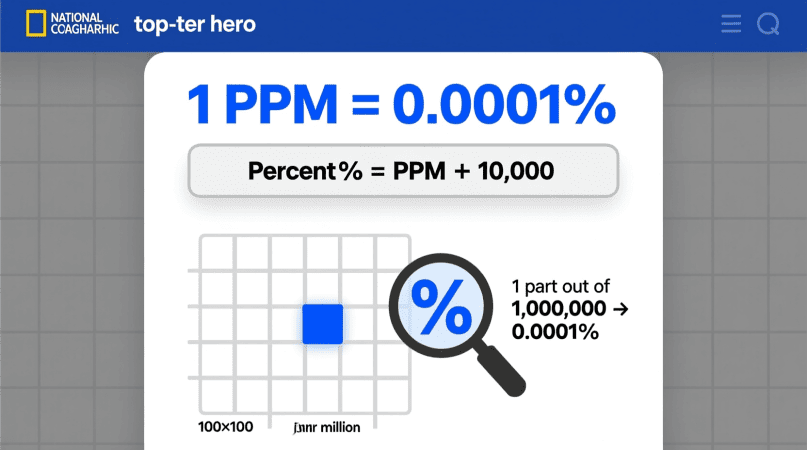
1 ppm=0.0001%
✅ Answer: 1 ppm = 0.0001%
This means that for every million parts, one part of solute makes up 0.0001 percent of the total mixture.
For anyone who doesn’t want to calculate manually, try the PPM to Percent Calculator — it gives instant and accurate conversions for any ppm value.
The Formula to Convert PPM to Percent
Here’s the universal formula you can use:
Percent=PPM/10,000
Now plug in the value:
1÷10,000=0.0001%
That’s it.
If you ever need to reverse the conversion (percent to ppm), multiply by 10,000 instead.
Example: 0.0001%×10,000=1 ppm
Where 1 PPM Is Commonly Seen
Even though 1 ppm sounds tiny, it’s often used in practical and scientific settings:
- In water testing:
1 ppm of chlorine equals 0.0001% chlorine in water — a trace but measurable concentration. Check more examples with the Chlorine PPM Calculator. - In air quality:
1 ppm of a gas like carbon monoxide or ozone is a common threshold in environmental monitoring — discover more about measurement units in What Is PPM?. - In agriculture:
1 ppm of micronutrients such as iron or zinc can affect plant growth in hydroponic systems. You can use the Nutrient PPM Calculator to balance nutrient levels precisely. - In lab experiments:
Scientists use 1 ppm to represent trace solute concentrations in chemical solutions — find detailed examples in the How to Calculate PPM in Chemistry guide.
Why Converting 1 PPM to Percent Matters
While ppm provides high precision, percentages make it easier to visualize scale.
For example:
- 1 ppm = 0.0001%
- 10 ppm = 0.001%
- 100 ppm = 0.01%
This conversion helps you interpret sensor readings, safety limits, and dosing calculations correctly across labs, water systems, and agricultural setups.
For more accurate solution preparation, visit the PPM Solution Calculator.
Common Mistakes When Converting
- Dividing by 1000 instead of 10,000, which leads to a tenfold error.
- Forgetting the percent sign (%), which can change the meaning of results.
- Assuming ppm equals mg/L in all contexts — they align only in water-based solutions.
Avoid these simple mistakes to maintain accuracy in lab or field calculations.
Summary
1 ppm equals 0.0001%.
That small number represents a trace-level concentration — essential in water testing, chemistry, and nutrient management.
For quick conversions, accurate calculators, and practical examples, visit PPMCalculator — your trusted resource for ppm, percent, and solution concentration tools.
Matthew is a chemical technology enthusiast and the creator of PPMCalculator.com — a platform dedicated to simplifying complex concentration and conversion formulas for students, researchers, and industry professionals. With years of experience exploring water chemistry, environmental monitoring, and laboratory analysis, he focuses on making scientific accuracy both practical and accessible.
When not writing or developing new tools, Shimul enjoys testing real-world chemical measurements, refining calculator algorithms, and helping learners understand the science behind PPM, EC, and TDS.