
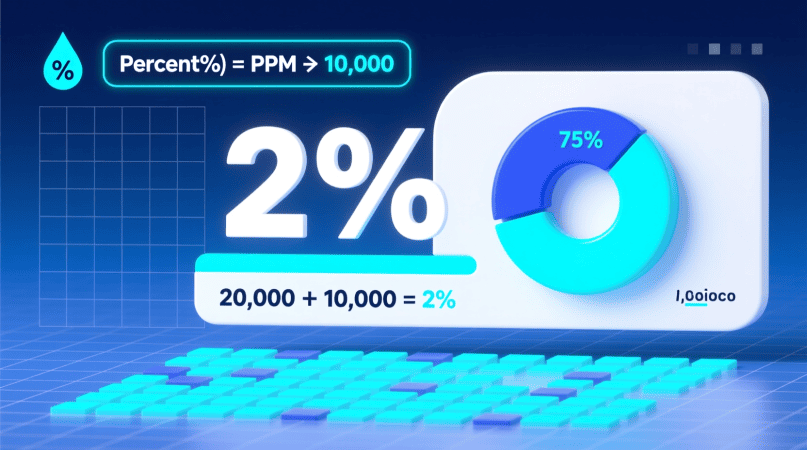
Convert 20,000 ppm to percent (2%) using a simple formula. Learn what parts per million mean, how ppm relates to percentages, and where 20,000 ppm concentrations appear in labs, water, and industry at PPMCalculator.
Understanding 20,000 PPM
When you read 20,000 ppm (parts per million), it represents 20,000 parts of a substance per one million parts of solution.
That’s a concentration often seen in industrial fluids, fertilizer solutions, and chemical dosing systems — where ppm offers a more precise measure than percentages for small-scale mixing.
To express this in everyday terms, let’s convert it to a percentage.
How to Convert 20,000 PPM to Percent
The basic conversion rule is consistent:
1 ppm=0.0001%
Therefore:
20,000 ppm=20,000×0.0001=2%
✅ Answer: 20,000 ppm = 2%
That means the substance makes up two percent of the total solution. This is a straightforward but powerful conversion — especially for anyone adjusting concentrations in labs, hydroponic systems, or water-treatment plants.
If you prefer instant results, try the PPM to Percent Calculator — it handles all ppm-to-percent conversions automatically.
The Formula for PPM to Percent Conversion
You can always use this formula:
Percent=PPM/10,000
Substitute the value:
20,000÷10,000=2%
If you need the reverse (percent → ppm), multiply by 10,000: 2%×10,000=20,000ppm
You’ll find more examples in the PPM Conversion Table, which lists common values like 1,000 ppm = 0.1%, 10,000 ppm = 1%, and 20,000 ppm = 2%.
Real-World Examples of 20,000 PPM
1. In Water Treatment:
A saline solution containing 20,000 ppm sodium chloride equals 2% salt by weight. That concentration is typical in brine systems or desalination tests. See how this compares with other salinity levels using the TDS to PPM Calculator.
2. In Agriculture & Hydroponics:
Some nutrient concentrates for stock tanks may contain 20,000 ppm of a micronutrient like calcium or potassium — that’s a 2% solution. Use the Nutrient PPM Calculator to balance concentrations safely.
3. In Manufacturing & Quality Control:
An impurity level of 20,000 ppm in a chemical mix is 2%, a critical value in purity analysis and defect tracking. For precision work, the PPM Accuracy Calculator can help evaluate acceptable limits.
4. In Chemistry Labs:
When preparing 2% acid or salt solutions, it’s useful to view that as 20,000 ppm for exact dosage. The PPM Solution Calculator makes this conversion easy for lab technicians.
Why Understanding This Conversion Matters
Switching between ppm and percent helps you interpret results consistently.
For example:
- 20,000 ppm of TDS in water equals 2%, indicating very hard or saline conditions.
- 20,000 ppm of nutrients in a fertilizer solution is a manageable strength for stock mixes.
- 20,000 ppm of impurities in production might exceed specifications by a large margin.
Clear understanding prevents overdosing, equipment damage, and lab misreporting.
You can deepen your understanding of this relationship in What Is PPM? and How to Calculate PPM in Chemistry.
Common Conversion Mistakes
- Dividing by 1000 instead of 10,000.
- Rounding 2% as 0.02 without including the symbol (%).
- Confusing ppm with mg/L — they’re equivalent only in water solutions.
Summary
20,000 ppm equals 2%.
This conversion is essential when moving from micro-scale ppm readings to percentage concentrations used in lab, industrial, or agricultural settings.
For precise calculations, tables, and advanced tools, visit PPM Calculator — your trusted source for ppm, percent, and solution conversions.
Matthew is a chemical technology enthusiast and the creator of PPMCalculator.com — a platform dedicated to simplifying complex concentration and conversion formulas for students, researchers, and industry professionals. With years of experience exploring water chemistry, environmental monitoring, and laboratory analysis, he focuses on making scientific accuracy both practical and accessible.
When not writing or developing new tools, Shimul enjoys testing real-world chemical measurements, refining calculator algorithms, and helping learners understand the science behind PPM, EC, and TDS.