
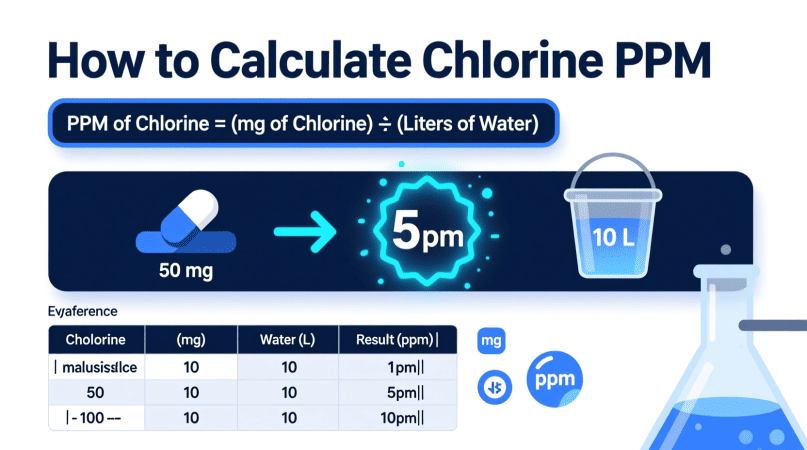
Learn how to figure out PPM per gallon using easy formulas and examples. Understand how to calculate parts per million for any solution in gallons, plus tools to simplify your conversions.
What Does PPM per Gallon Mean?
PPM (parts per million) measures how many parts of a solute (like salt, nutrients, or chemicals) are present in one million parts of a solution.
When working with gallons, you’re usually trying to find out how much of a substance (in milligrams or grams) to add per gallon of water to reach a target concentration.
This is common in:
- Hydroponics and gardening
- Pool and spa maintenance
- Chemical mixing and dosing
- Water testing and sanitation
The Basic Formula for PPM per Gallon
The general formula to calculate PPM per gallon is:
PPM = {mg of solute} / {liters of solution}
Since 1 US gallon = 3.785 liters, we can adapt it for gallons:
PPM per gallon = mg of solute/3.785
Or, to find how many milligrams (or grams) you need for a target PPM:
mg of solute=PPM×3.785
Example 1 – How Many mg per Gallon for 100 PPM?
If your target is 100 ppm:
mg=100×3.785=378.5mg
✅ Result: You need 378.5 mg (or 0.378 g) of solute per gallon of water to get 100 ppm.
You can verify your math with our PPM Solution Calculator.
Example 2 – Finding PPM from Grams per Gallon
If you added 2 grams of solute per gallon:
- Convert grams to mg → 2 × 1000 = 2000 mg
- Apply the formula: PPM = 2000 / 3.785 = 528.7 ppm
✅ Result: 2 grams per gallon equals roughly 529 ppm.
This method works for fertilizers, chlorine, or any dissolved compound.
If you want to double-check conversions, try the PPM to Grams Calculator.
Shortcut Formula for Everyday Use
A simpler version that’s often used in the field:
PPM = (grams × 1000) ÷ 3.785
Or reversed:
grams = (PPM × 3.785) ÷ 1000
You can easily calculate these values using the main PPM Calculator on our homepage.
Example 3 – PPM per Gallon for Fertilizer Mixing
Let’s say you want to mix a nutrient solution for hydroponics at 250 ppm nitrogen.
- The fertilizer’s N content = 10% (0.10 fraction)
- Solution volume = 1 gallon (3.785 L)
Step 1: Convert desired ppm to mg/L → 250 mg/L
Step 2: Multiply by liters → 250 × 3.785 = 946.25 mg
Step 3: Divide by the N fraction → 946.25 ÷ 0.10 = 9462.5 mg (≈ 9.46 g fertilizer)
✅ Add about 9.5 g of fertilizer per gallon to achieve 250 ppm N.
For more accurate nutrient prep, try our Nutrient PPM Calculator or read the Hydroponics PPM Guide.
Converting Between Units
Sometimes you’ll need to switch between PPM, mg/L, and % concentration.
Use these quick conversions:
- 1 PPM = 1 mg/L
- 1% = 10,000 PPM
- 1 gallon = 3.785 L
Our PPM to Percent Calculator and PPM Conversion Tools make these conversions fast and reliable.
Real-World Examples OF ppm per gallon
1. Water Chlorination
If you want 2 ppm chlorine in 1 gallon: 2×3.785=7.57mg chlorine
So, adding 7.6 mg of chlorine per gallon gives you a 2 ppm concentration.
See our Chlorine PPM Calculator for safety ranges and dosage tips.
2. Pool Maintenance
A pool needs 4 ppm free chlorine — scaling this formula across thousands of gallons ensures consistent disinfection.
3. Agriculture
Fertilizer and pesticide formulations often specify dosage in ppm.
Knowing ppm per gallon helps avoid underdosing or nutrient burn.
You can also explore Agriculture and Fertilizer PPM Calculations.
Common Mistakes to Avoid:
- Forgetting to Convert Gallons to Liters
Always multiply by 3.785 for U.S. gallons. - Using Percent Instead of Fraction
When working with fertilizer percentages, convert to decimal form. - Ignoring Water Density
These formulas assume pure water (1 g/mL). Heavy or saline water may require small adjustments. - Rounding Too Early
Keep at least 2–3 decimal places during calculations for accurate dosing.
Matthew is a chemical technology enthusiast and the creator of PPMCalculator.com — a platform dedicated to simplifying complex concentration and conversion formulas for students, researchers, and industry professionals. With years of experience exploring water chemistry, environmental monitoring, and laboratory analysis, he focuses on making scientific accuracy both practical and accessible.
When not writing or developing new tools, Shimul enjoys testing real-world chemical measurements, refining calculator algorithms, and helping learners understand the science behind PPM, EC, and TDS.