
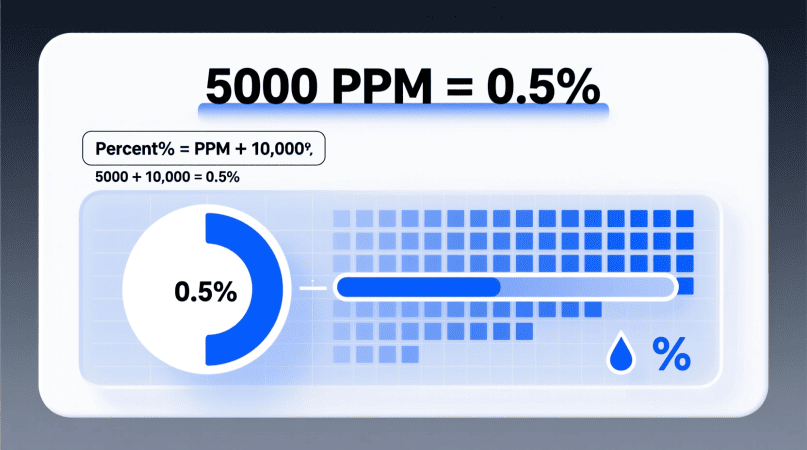
Learn how to convert 5000 ppm to percent (0.5%) with a simple formula and examples. Understand what ppm means in chemistry, water testing, and fertilizer mixing.
Understanding What 5000 PPM Means
The term ppm, or parts per million, measures how much of a substance is present within a solution or mixture.
When you see 5000 ppm, it means 5000 parts of solute exist in one million parts of total solution.
It’s a practical way to describe small concentrations that are too subtle for regular percentages — but we can still convert ppm to percent for easier comparison.
How to Convert 5000 PPM to Percent
The relationship between ppm and percent is constant:
1 ppm=0.0001%
Therefore:
5000 ppm=5000×0.0001=0.5%
✅ Answer: 5000 ppm = 0.5%
That means the concentration of a 5000 ppm solution equals half of one percent of the total mixture.
If you prefer not to calculate manually, you can use the PPM to Percent Calculator — it instantly converts ppm values to percentages with perfect accuracy.
Formula for PPM to Percent Conversion
The universal formula for ppm to percent is:
Percent=PPM/10,000
Substitute the value:
5000÷10,000=0.5%
To reverse this, multiply by 10,000.
For instance: 0.5%×10,000=5000 ppm
For quick comparisons of other common conversions, check the PPM Conversion Table.
Real-World Examples of 5000 PPM
- In water testing:
5000 ppm of total dissolved solids equals 0.5% impurity — quite high for drinking water but normal for seawater or brine. You can analyze similar values with the TDS to PPM Calculator. - In agriculture or hydroponics:
A fertilizer mix at 5000 ppm provides a 0.5% nutrient concentration, often used for stock or concentrated nutrient solutions. The Nutrient PPM Calculator can help you fine-tune ratios. - In chemistry labs:
5000 ppm may represent 0.5% of a solute in solution — a moderate concentration used in testing reagents. For accurate formulations, use the PPM Solution Calculator. - In pool maintenance:
5000 ppm salt equals a 0.5% salinity, a typical range for saltwater pools. You can cross-check optimal salt levels using the Salt Pool PPM Calculator.
Each of these applications shows how ppm and percentage express the same ratio, just on different scales.
Why Knowing 5000 PPM Equals 0.5% Matters
Understanding the ppm-to-percent relationship prevents dosing mistakes, over-concentration, or inaccurate readings.
A small miscalculation can double or halve a solution’s strength, affecting water quality, plant health, or lab accuracy.
Knowing that 5000 ppm = 0.5% helps you interpret sensor readings, lab data, or fertilizer instructions correctly.
You can learn more about ppm fundamentals in What Is PPM? and How to Calculate PPM in Chemistry.
Common Conversion Mistakes
- Dividing by 1000 instead of 10,000 (this produces 5% instead of 0.5%).
- Confusing ppm with mg/L — they’re equivalent in water but not in air or solids.
- Forgetting to include the percent sign when reporting results.
Summary
5000 ppm equals 0.5%.
It’s a moderate concentration — common in fertilizers, saline water, and industrial mixtures.
For quick, precise conversions, calculators, and science-backed examples, visit PPMCalculator — your trusted source for ppm, percent, and concentration calculations.
Matthew is a chemical technology enthusiast and the creator of PPMCalculator.com — a platform dedicated to simplifying complex concentration and conversion formulas for students, researchers, and industry professionals. With years of experience exploring water chemistry, environmental monitoring, and laboratory analysis, he focuses on making scientific accuracy both practical and accessible.
When not writing or developing new tools, Shimul enjoys testing real-world chemical measurements, refining calculator algorithms, and helping learners understand the science behind PPM, EC, and TDS.