
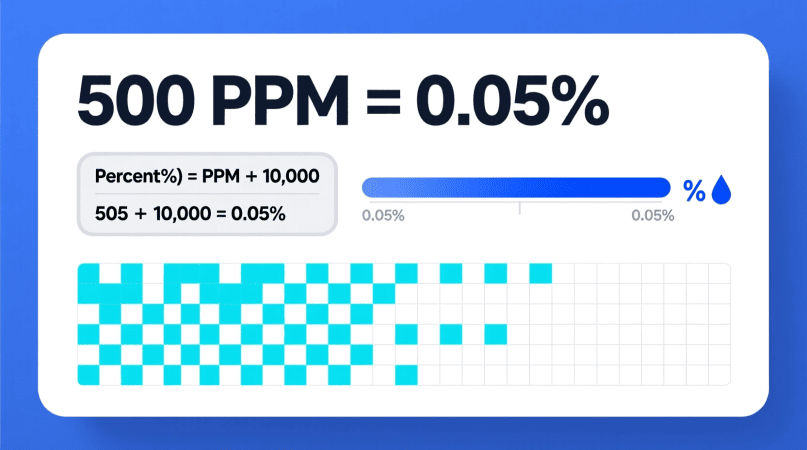
Convert 500 ppm to percent (0.05%) easily. Learn what ppm means, how to calculate it, and how ppm relates to percentages in water, fertilizer, and chemistry at PPMCalculator.
Understanding 500 PPM
When you come across a reading of 500 ppm, it means 500 parts of a substance per one million parts of total mixture.
PPM — parts per million — is a common unit for measuring very small concentrations. It’s often used in chemistry labs, water testing, pool maintenance, fertilizer mixing, and industrial quality control.
Because ppm expresses such fine precision, it can sometimes be hard to visualize. That’s why many people convert it to percent, a unit that’s more intuitive for everyday use.
How to Convert 500 PPM to Percent
The conversion between ppm and percent is simple and constant:
1 ppm=0.0001%
So:
500×0.0001=0.05%
✅ Answer: 500 ppm = 0.05%
This means that 500 ppm equals five hundred parts out of a million, or half of one-tenth of a percent.
If you’d like to skip the math, you can use the PPM to Percent Calculator — it handles instant conversions for any ppm value, big or small.
PPM to Percent Conversion Formula
The standard formula for conversion is:
Percent=PPM/10,000
So:
500÷10,000=0.05%
This formula also works in reverse.
To convert percent to ppm, multiply by 10,000:
0.05%×10,000=500 ppm
For quick reference, visit the PPM Conversion Table, which lists common values like 1 ppm = 0.0001%, 100 ppm = 0.01%, and 10,000 ppm = 1%.
Real-World Examples of 500 PPM
1. Water Testing
A TDS (total dissolved solids) level of 500 ppm equals 0.05% impurity — that’s near the upper limit for acceptable drinking water quality.
You can explore related conversions with the TDS to PPM Calculator.
2. Pool and Spa Maintenance
Saltwater pools often contain several thousand ppm of salt, but 500 ppm can represent trace chemicals or sanitizer residuals.
Check chlorine strength with the Chlorine PPM Calculator or adjust salinity using the Salt Pool PPM Calculator.
3. Agriculture and Fertilizer Mixing
In hydroponics or soil nutrition, 500 ppm nitrogen equals 0.05% nutrient concentration, suitable for early-stage feeding.
For precise balancing, use the Nutrient PPM Calculator.
4. Laboratory or Industrial Use
In chemical labs, 500 ppm = 0.05% is a moderate concentration used in reagent solutions or impurity testing.
To design these mixtures accurately, try the PPM Solution Calculator.
Why Understanding 500 PPM Conversion Matters
Converting ppm to percent bridges scientific precision with everyday clarity.
If a report shows 500 ppm of chlorine or minerals, you now know it equals 0.05%, helping you interpret concentration data correctly.
This understanding supports better decisions in quality control, nutrient dosing, and water management.
For background reading, explore What Is PPM? and How to Calculate PPM in Chemistry — two cornerstone guides explaining ppm from basics to applied calculations.
Common Mistakes in PPM Conversions
- Dividing by 1000 instead of 10,000, which gives the wrong percentage.
- Rounding too early, which reduces accuracy.
- Assuming ppm equals mg/L in all contexts — this is true only for water, not gases or solids.
Summary
500 ppm equals 0.05%.
It’s a small but meaningful concentration used in lab chemistry, fertilizers, and water analysis.
For accurate, instant conversions and detailed learning resources, visit PPMCalculator — your trusted source for ppm, percent, and solution-based measurements.
Matthew is a chemical technology enthusiast and the creator of PPMCalculator.com — a platform dedicated to simplifying complex concentration and conversion formulas for students, researchers, and industry professionals. With years of experience exploring water chemistry, environmental monitoring, and laboratory analysis, he focuses on making scientific accuracy both practical and accessible.
When not writing or developing new tools, Shimul enjoys testing real-world chemical measurements, refining calculator algorithms, and helping learners understand the science behind PPM, EC, and TDS.