Convert 3 ppm to percent (0.0003%) using an easy formula. Learn what ppm means, how to calculate it, and where it’s used in chemistry, water testing, and everyday science on PPM Calculator.
Understanding What 3 PPM Means
When you read “3 ppm,” it stands for 3 parts per million — a measure of concentration that shows how much of a substance exists within a solution or mixture.
It’s a unit that appears everywhere: in water quality reports, lab tests, and even food safety data.
In simple terms, 1 ppm equals one part of a substance in one million total parts. This scale is great for describing trace quantities — things so small they can’t easily be measured in percentages without converting.
How to Convert 3 PPM to Percent
The relationship between ppm and percent is straightforward.
1 ppm=0.0001%
To convert 3 ppm to percent, multiply by 0.0001:
3 ppm=3×0.0001=0.0003%
✅ Answer: 3 ppm = 0.0003%
If math isn’t your thing, the easiest way to do this is by using the PPM to Percent Calculator. It’s fast, accurate, and ideal for converting any value — whether you’re working with 3 ppm, 50 ppm, or 1000 ppm.
Formula for PPM to Percent Conversion
You can also think of it as a formula:
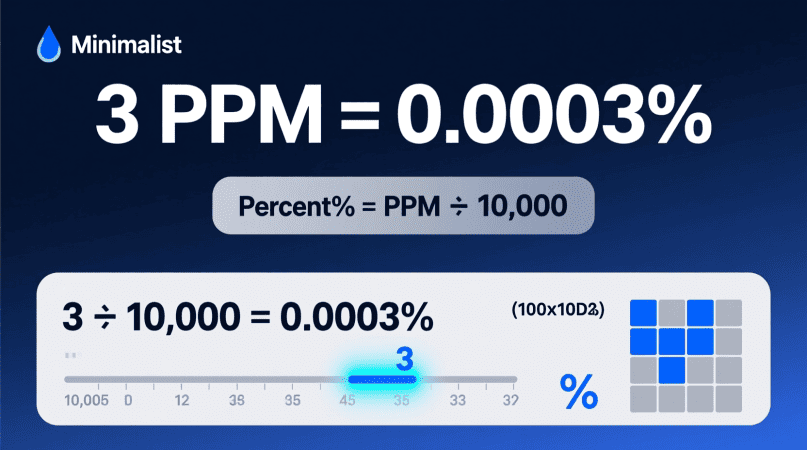
Percentage = PPM / 10,000
For 3 ppm: 3÷10,000=0.0003%
This formula works both ways. To find ppm from percent, multiply the percentage by 10,000.
If you’d like to experiment with other conversions, try the PPM Solution Calculator or the PPM Conversion Table.
Why the 3 PPM to Percent Conversion Matters
Even though 3 ppm seems small, in chemistry or environmental monitoring, that concentration can be significant. For example:
- In drinking water, 3 ppm of chlorine is typical for safe disinfection levels. You can explore this topic in the Chlorine PPM Calculator.
- In lab experiments, 3 ppm could indicate the concentration of trace metals or contaminants — explained more in the How to Calculate PPM in Chemistry guide.
- In agriculture or hydroponics, nutrient concentration at 3 ppm may apply to micronutrients like zinc or iron. For accurate plant feeding, check the Nutrient PPM Calculator.
Understanding ppm-to-percent conversions helps bridge what digital meters display (ppm) with how reports and specifications are written (percentages).
Common Mistakes When Converting
- Using 1000 instead of 10,000 — which makes your percentage ten times too high.
- Rounding too soon — always keep at least four decimal places for ppm-level accuracy.
- Assuming ppm and mg/L are always identical — they match in water but differ in gases or solids.
In Summary
3 ppm equals 0.0003%.
It’s a small number, but essential in understanding precision measurements in chemistry, agriculture, and environmental science.
Whenever you need a quick, verified conversion, visit the trusted PPM Calculator — your home for accurate ppm, percent, and concentration conversions.
Matthew is a chemical technology enthusiast and the creator of PPMCalculator.com — a platform dedicated to simplifying complex concentration and conversion formulas for students, researchers, and industry professionals. With years of experience exploring water chemistry, environmental monitoring, and laboratory analysis, he focuses on making scientific accuracy both practical and accessible.
When not writing or developing new tools, Shimul enjoys testing real-world chemical measurements, refining calculator algorithms, and helping learners understand the science behind PPM, EC, and TDS.