Easily convert 2000 ppm to percent (0.2%) with a quick formula and examples from chemistry, agriculture, and water testing.
What Does 2000 PPM Mean?
The abbreviation ppm stands for parts per million, a unit used to express very small concentrations.
When you read 2000 ppm, it literally means there are 2000 parts of a solute (such as salt, chlorine, or nutrients) in one million parts of total mixture.
This scale is common in water analysis, fertilizer preparation, hydroponic systems, chemistry labs, and manufacturing where precision matters.
To make it more intuitive, ppm values are often converted into percent by weight.
How to Convert 2000 PPM to Percent
The relationship between ppm and percent is constant:
1 ppm=0.0001%
So the conversion is simple:
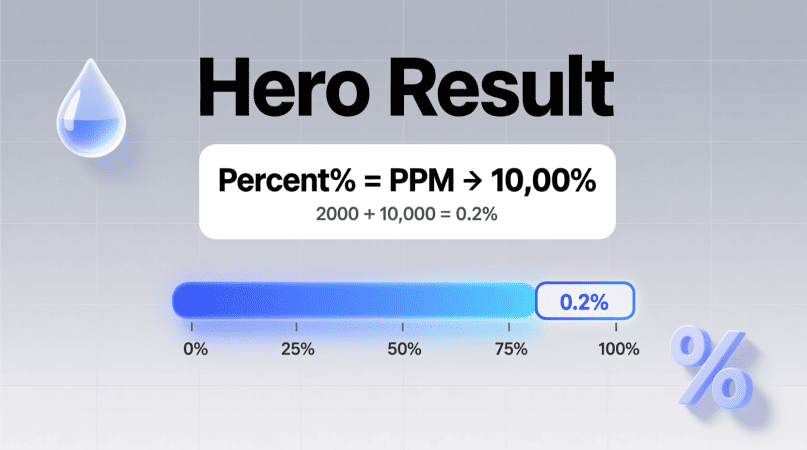
2000×0.0001=0.2%
✅ Answer: 2000 ppm = 0.2 percent
That means a 2000 ppm solution contains 0.2% of the solute by total mass or volume.
If you’d like to check this instantly, try the PPM to Percent Calculator for quick, verified conversions.
Formula for PPM to Percent
Use this universal equation for any conversion:
Percent=PPM/10,000
Applying it:
2000÷10,000=0.2%
To reverse it (percent → ppm):
0.2%×10,000=2000ppm
For reference tables of common values, visit the PPM Conversion Table.
Real-World Examples of 2000 PPM
1. Water Testing
If your water sample shows 2000 ppm TDS (total dissolved solids), it means 0.2% impurities.
That level is too high for drinking water but acceptable for industrial or agricultural use.
Cross-check readings using the TDS to PPM Calculator.
2. Agriculture and Hydroponics
A nutrient mix at 2000 ppm nitrogen equals a 0.2% nutrient solution, ideal for mature plants in high-growth stages.
You can fine-tune formulations with the Nutrient PPM Calculator.
3. Pool and Spa Care
A 2000 ppm salt level equals 0.2% salinity, slightly below the range used for saltwater pools.
Adjust levels precisely using the Salt Pool PPM Calculator or test sanitizer levels via the Chlorine PPM Calculator.
4. Chemistry and Lab Use
In laboratories, a 2000 ppm solution (0.2%) might represent a reagent, acid, or impurity concentration.
Prepare exact mixtures with the PPM Solution Calculator.
Why the Conversion Matters
Converting ppm to percent helps bridge scientific notation and practical understanding.
A chlorine solution labeled 2000 ppm might sound small, but knowing it equals 0.2% ensures the right concentration for cleaning or analysis.
This conversion also helps avoid dosing mistakes in hydroponics, chemical mixing, and environmental testing.
If you’re new to ppm concepts, start with What Is PPM? for a complete beginner-friendly explanation.
Common Conversion Errors
- Dividing by 1000 instead of 10,000 — resulting in a ten-fold error.
- Confusing ppm with mg/L — they’re equal only in water-based solutions.
- Rounding too early — always keep four decimal places for ppm-level accuracy.
For accurate results, rely on the PPMCalculator for automated conversions and examples.
Summary
2000 ppm = 0.2%.
That’s two-tenths of a percent — a moderate concentration used in many scientific and industrial applications.
Matthew is a chemical technology enthusiast and the creator of PPMCalculator.com — a platform dedicated to simplifying complex concentration and conversion formulas for students, researchers, and industry professionals. With years of experience exploring water chemistry, environmental monitoring, and laboratory analysis, he focuses on making scientific accuracy both practical and accessible.
When not writing or developing new tools, Shimul enjoys testing real-world chemical measurements, refining calculator algorithms, and helping learners understand the science behind PPM, EC, and TDS.