Learn how to convert 200 ppm to percent (0.02%) using a simple formula. Understand what ppm means, when to use it, and see real-life examples from chemistry, water testing, and agriculture at PPMCalculator.
Understanding 200 PPM
When you read 200 ppm, it stands for 200 parts per million — a common way to express the concentration of a substance within a solution or mixture.
It simply means 200 parts of a solute per one million parts of the total mixture.
This small-scale unit is widely used in chemistry labs, agriculture, water treatment, and environmental monitoring.
Because ppm values can look abstract, converting them to percent by weight makes them easier to understand.
How to Convert 200 PPM to Percent
The conversion between ppm and percent is direct and easy to remember:
1 ppm=0.0001%
So to find the percentage:
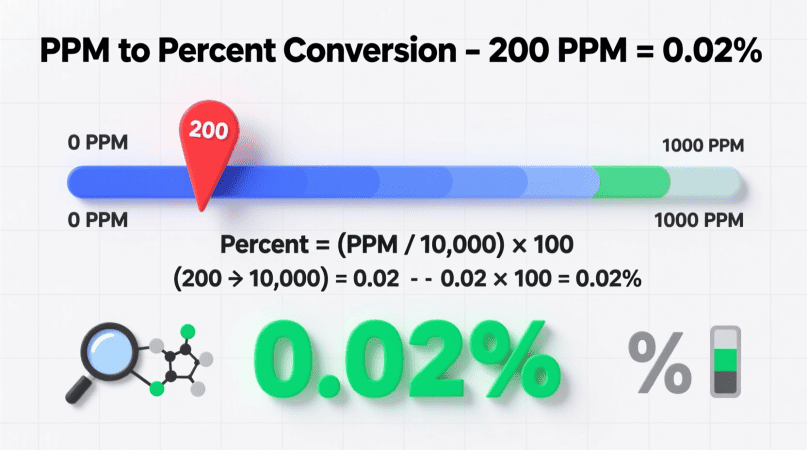
200×0.0001=0.02%
✅ Answer: 200 ppm = 0.02%
That means the solute makes up 0.02 percent of the total mixture.
To verify this or calculate any other conversion instantly, use the PPM to Percent Calculator.
Formula for PPM to Percent Conversion
The general equation for converting ppm to percent is: Percent=PPM/10,000
For 200 ppm: 200÷10,000=0.02%
If you need the reverse calculation (percent to ppm), multiply the percentage by 10,000: 0.02%×10,000=200 ppm
To explore additional examples, check the PPM Conversion Table — it lists quick reference values for common conversions like 10 ppm, 1000 ppm, and 10,000 ppm.
Real-Life Examples of 200 PPM
1. In Water Testing
If your water has 200 ppm of dissolved solids, that’s 0.02% impurity. It indicates moderately mineralized water — still safe for most uses. You can analyze your readings further with the TDS to PPM Calculator.
2. In Agriculture and Hydroponics
A fertilizer or nutrient solution at 200 ppm nitrogen equals 0.02% nitrogen concentration, ideal for seedlings and early growth. Try the Nutrient PPM Calculator to customize feeding ratios.
3. In Pool Maintenance
A salt concentration of 200 ppm equals 0.02% salinity — a low but measurable level. Compare pool salinity and sanitizer concentrations using the Salt Pool PPM Calculator or Chlorine PPM Calculator.
4. In Chemistry Labs
Chemists often express trace elements or contaminants in ppm.
For example, 200 ppm = 0.02% concentration of solute in a solvent — a typical level for reagent testing. For lab-specific calculations, use the PPM Solution Calculator.
Why Converting PPM to Percent Matters
Understanding ppm-to-percent conversions helps interpret data correctly in reports and instruments.
For instance, a chlorine reading of 200 ppm equals 0.02%, not 2% — a huge difference in dosing accuracy.
It ensures precision in quality control, nutrient mixing, and environmental compliance.
If you’re new to the concept, start with What Is PPM? for foundational knowledge.
Common Mistakes
- Dividing by 1000 instead of 10,000 — producing a 10× error.
- Confusing ppm with mg/L — they’re equivalent in water, not in gases or solids.
- Rounding too early, which can distort small ppm values.
To avoid these, always verify your numbers using the trusted PPMCalculator.
Summary
200 ppm equals 0.02%.
It’s a small yet measurable concentration relevant to chemistry, agriculture, and water testing.
Matthew is a chemical technology enthusiast and the creator of PPMCalculator.com — a platform dedicated to simplifying complex concentration and conversion formulas for students, researchers, and industry professionals. With years of experience exploring water chemistry, environmental monitoring, and laboratory analysis, he focuses on making scientific accuracy both practical and accessible.
When not writing or developing new tools, Shimul enjoys testing real-world chemical measurements, refining calculator algorithms, and helping learners understand the science behind PPM, EC, and TDS.