Convert 100 ppm to percent (0.01%) quickly and understand what this concentration means in water, chemistry, and agriculture.
What Does 100 PPM Mean?
The term ppm (parts per million) describes how much of one substance exists in a million parts of another.
When you see 100 ppm, it means there are 100 parts of solute (like salt, chlorine, or nutrients) in 1,000,000 parts of total solution.
This unit is commonly used in chemistry, lab testing, water treatment, fertilizers, and environmental monitoring to express very small concentrations with accuracy.
To interpret it in more familiar terms, we can convert ppm into a percentage.
How to Convert 100 PPM to Percent
The relationship between ppm and percent is simple:
1 ppm=0.0001%
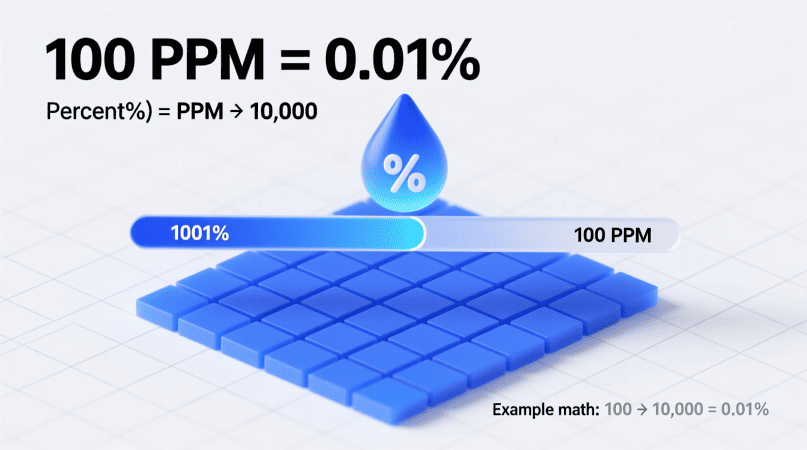
So: 100 ppm=100×0.0001=0.01%
✅ Answer: 100 ppm = 0.01%
That means a solution with 100 ppm concentration contains 0.01% of the substance by mass or volume.
If you prefer quick, verified calculations, use the PPM to Percent Calculator — it converts ppm, mg/L, or even ppb to percentages instantly.
The Formula Behind the Conversion
You can find any ppm-to-percent value using this formula:
Percent= PPM/10,000
Applying this to 100 ppm: 100÷10,000=0.01%
This formula works for any value.
If you want to reverse it — converting percent to ppm — simply multiply by 10,000.
For example: 0.01%×10,000=100 ppm
Check out the PPM Conversion Table for a ready-made list of similar conversions.
Practical Examples of 100 PPM
Understanding 100 ppm in context makes it easier to grasp its real-world meaning:
- In water testing: 100 ppm of total dissolved solids equals 0.01% impurity — a reasonable concentration for drinking water. You can explore this with the TDS to PPM Calculator.
- In pool care: 100 ppm chlorine (0.01%) would be excessive, but 100 ppm of stabilizer or calcium hardness might be typical. Use the Chlorine PPM Calculator for safe ranges.
- In agriculture: A nutrient mix with 100 ppm nitrogen provides 0.01% concentration — perfect for early plant growth. Try the Nutrient PPM Calculator to customize ratios.
- In lab or industrial use: 100 ppm of a contaminant equals 0.01%, often the threshold for quality control or purity checks. Learn more in the How to Calculate PPM in Chemistry guide.
Why Knowing the Conversion Helps
Understanding ppm-to-percent conversions helps bridge how scientists, engineers, and everyday users interpret data.
A 100 ppm reading on a meter can sound small — but 0.01% concentration can have a meaningful impact in chemical processes, nutrient dosing, or pollution control.
Accurate interpretation helps ensure compliance with safety limits, quality standards, and precise formulation in labs or agriculture.
If you’re working with mixed units (mg/L, % w/w, etc.), the PPM Solution Calculator makes the math effortless.
Common Conversion Errors
- Using 1000 instead of 10,000 for division — this makes results ten times too high.
- Ignoring unit context — ppm in gases, solids, and liquids don’t always translate the same.
- Rounding too early — for ppm work, precision matters. Keep at least four decimal places.
Summary
100 ppm equals 0.01%.
This simple conversion reveals that even tiny concentrations can be critical in science, environment, and manufacturing.
For instant and accurate conversions, visit PPM Calculator — your trusted tool for ppm, percent, and solution-based calculations.
Matthew is a chemical technology enthusiast and the creator of PPMCalculator.com — a platform dedicated to simplifying complex concentration and conversion formulas for students, researchers, and industry professionals. With years of experience exploring water chemistry, environmental monitoring, and laboratory analysis, he focuses on making scientific accuracy both practical and accessible.
When not writing or developing new tools, Shimul enjoys testing real-world chemical measurements, refining calculator algorithms, and helping learners understand the science behind PPM, EC, and TDS.