Convert 10 ppm to percent (0.001%) using a simple formula. Learn what parts per million means, how to calculate it, and where 10 ppm concentrations appear in chemistry, water testing, and agriculture at PPMCalculator.
What Does 10 PPM Mean?
If you’ve ever seen 10 ppm on a lab report, pool test, or fertilizer label, it means 10 parts of a substance per million parts of solution.
PPM — short for parts per million — is a standard way to measure very small concentrations, often when percentages would be too large to express precision.
For example, if a nutrient solution has 10 ppm of iron, it means that for every million parts of water, there are ten parts of iron. To make this easier to understand, let’s convert it to a percentage.
How to Convert 10 PPM to Percent
The relationship between ppm and percentage is fixed and simple:
[
1\ \text{ppm} = 0.0001%
]
So:
[
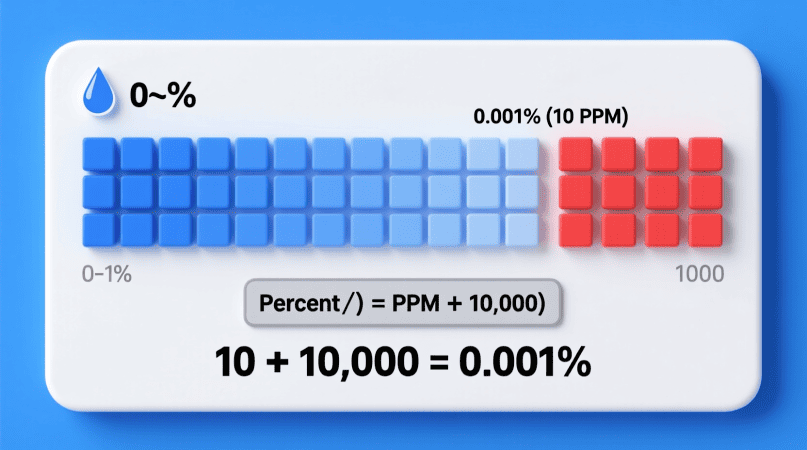
10\ \text{ppm} = 10 × 0.0001 = 0.001%
]
✅ Answer: 10 ppm = 0.001%
That means a concentration of 10 ppm equals 0.001 percent — an extremely small amount, but significant in water chemistry or nutrient management.
If you want to confirm instantly, use the PPM to Percent Calculator for quick and accurate conversions.
The Formula for Converting PPM to Percentage
Here’s the universal formula you can use for any ppm value:
1 ppm=0.0001%
Plug in the value: 10 ppm=10×0.0001=0.001%
To reverse the process (percent to ppm), multiply by 10,000.
For example, 0.001% × 10,000 = 10 ppm — proving the conversion goes both ways.
You can explore similar relationships in the PPM Conversion Table for quick reference.
Where 10 PPM Is Commonly Used
Understanding 10 ppm helps in a wide range of real-world situations:
- Water testing: A chlorine reading of 10 ppm equals 0.001% chlorine in water. Check with the Chlorine PPM Calculator to see ideal pool levels.
- Agriculture: Nutrient solutions often use 10 ppm of trace elements like zinc or copper — vital for plant growth. Use the Nutrient PPM Calculator to adjust concentrations.
- Chemistry and lab work: 10 ppm may represent a trace contaminant or additive. Learn more in How to Calculate PPM in Chemistry.
- Drinking water safety: 10 ppm of total dissolved solids equals 0.001%, a clean and acceptable value. You can cross-check with the TDS to PPM Calculator.
Each field uses ppm differently, but the math behind the conversion stays the same.
Why Converting 10 PPM to Percent Matters
Knowing how to translate ppm into percent helps interpret reports and avoid misunderstandings. For example, a water test showing 10 ppm fluoride equals 0.001%, not 1% — a huge difference that affects safety decisions.
The ability to switch between units improves accuracy in quality control, hydroponic dosing, and chemical formulation. If you handle these numbers often, try the PPM Solution Calculator for precise mixing guidance.
Common Mistakes to Avoid
- Dividing by 1000 instead of 10,000.
- Rounding too soon — ppm conversions often require four decimal places.
- Assuming ppm = mg/L in every case — it’s true for water but not always for gases or solids.
For more clarity, see What Is PPM? — a complete guide to ppm meaning and usage.
Summary
10 ppm equals 0.001%.
This conversion shows how even trace amounts of substances can matter in chemistry, water quality, and agriculture.
For fast, reliable conversions and detailed guides, visit PPM Calculator — your trusted resource for ppm, percent, and concentration calculations.
Matthew is a chemical technology enthusiast and the creator of PPMCalculator.com — a platform dedicated to simplifying complex concentration and conversion formulas for students, researchers, and industry professionals. With years of experience exploring water chemistry, environmental monitoring, and laboratory analysis, he focuses on making scientific accuracy both practical and accessible.
When not writing or developing new tools, Shimul enjoys testing real-world chemical measurements, refining calculator algorithms, and helping learners understand the science behind PPM, EC, and TDS.