
PPM to CO₂ Calculator
Convert CO₂ between parts per million (PPMv) and mass concentration (mg/m³) using temperature & pressure.
mg/m³ = PPM × (MW / R) × (P / T)PPM = mg/m³ ÷ [(MW / R) × (P / T)]where MW = 44.01 g/mol (CO₂), R = 0.082057 L·atm/(mol·K)
Easy CO₂ PPM Calculator – Convert PPM to CO₂ Levels in Seconds
The concentration of carbon dioxide (CO₂) in the air is a critical measurement for a wide range of fields, from indoor air quality monitoring to industrial safety and environmental science.
While professional sensors often provide readings in parts per million (PPM), many regulations and scientific studies require these values to be converted to mass per volume, typically milligrams per cubic meter (mg/m3). Our PPM to CO₂ Converter is a simple, effective tool designed to perform this calculation for you, ensuring accuracy and saving you time.
How to Use the PPM to CO₂ Calculator
Using the PPM to CO₂ Converter is straightforward and requires no prior technical knowledge.
- Enter Your Value: Locate the input field on the calculator, labeled “Enter CO₂ Concentration in PPM.” Simply type in the CO₂ concentration value you have in parts per million. For example, if your sensor reads 400 PPM, you would enter “400”.
- Click to Convert: Once your number is entered, click the “Convert” button.
- View the Result: The calculator will instantly display the converted value in a clean, easy-to-read format. The result will be shown in milligrams per cubic meter (mg/m3), along with the original PPM value for reference. The tool is designed to handle a wide range of positive numerical inputs and will alert you with a helpful message if an invalid entry is made.
The Formula & Conversion Explained
Understanding the science behind the conversion is essential for appreciating why this calculator is so useful. The relationship between PPM (parts per million) and mass concentration (mg/m3) is not a fixed universal constant.
It depends on several factors, most notably the molecular weight of the gas and the prevailing temperature and pressure of the environment.
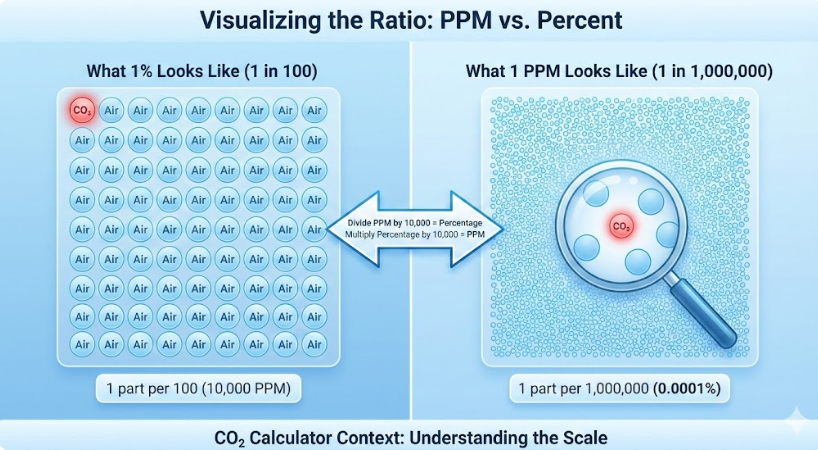
What is PPM?
PPM (parts per million) is a unit of concentration that represents the number of parts of a substance per million parts of the total mixture. It is a ratio, similar to a percentage, but used for very small quantities. For instance, 400 PPM of CO₂ means that for every one million particles of air, 400 of them are carbon dioxide molecules. This unit is popular because it’s easy to understand and is independent of temperature and pressure.
What is mg/m3?
mg/m3 (milligrams per cubic meter) is a unit of mass concentration. It measures the mass of a substance in milligrams that is present in one cubic meter of a mixture. This unit is often used in health and safety regulations because it directly relates to the physical mass of a substance that a person might inhale.
The Conversion Formula
To convert PPM to mg/m3, we use the following formula:

The conversion factor used in our calculator simplifies this process.
Deriving the Conversion Factor of 1.96
The PPM to CO₂ Converter uses a standard conversion factor of 1.96 mg/m3 per PPM. This value is derived for carbon dioxide at standard temperature and pressure (STP), which is defined as 0∘C (273.15 K) and 1 atmosphere (atm) of pressure.
Let’s break down the derivation:
- Molecular Weight of CO₂: The molecular weight of carbon dioxide (CO2) is approximately 44.01 g/mol. This is calculated from the atomic weights of carbon (12.01 g/mol) and oxygen (16.00 g/mol): 12.01+2×16.00=44.01 g/mol.
- Molar Volume at STP: According to the ideal gas law (PV=nRT), one mole of any ideal gas at STP occupies a volume of 22.4 liters.
- Calculation: Now we can calculate the mass of CO₂ per liter:22.4L/mol44.01g/mol≈1.9647g/LSince one cubic meter (m3) contains 1000 liters (L), and one gram (g) contains 1000 milligrams (mg), we can perform the final unit conversion. However, the standard conversion factor of 1.96 is more commonly used for simplicity, representing the density of CO₂ in grams per liter at STP.Therefore, the conversion from PPM to mg/m3 becomes:mg/m3=PPM×1.96
It’s important to remember that this PPM to CO₂ Converter uses this specific, widely accepted conversion factor. While highly accurate for most purposes, slight variations can occur with changes in ambient temperature and pressure.
Applications and Use Cases
The ability to quickly convert CO₂ concentration from PPM to mg/m3 is invaluable across many professional and personal applications.
Indoor Air Quality (IAQ)
In buildings, schools, and offices, monitoring indoor CO₂ levels is crucial for assessing air quality and ventilation. High CO₂ concentrations can lead to drowsiness, headaches, and a lack of focus. Many IAQ standards and regulations express limits in mg/m3, making this PPM to CO₂ Converter an essential tool for building managers, HVAC technicians, and facility professionals to ensure compliance and occupant well-being.
Industrial Safety and Confined Spaces
In industrial settings, particularly in confined spaces like sewers, basements, or storage tanks, elevated CO₂ levels can pose a serious health risk. Safety protocols often define maximum exposure limits in mg/m3. Industrial hygienists and safety officers use sensors that report in PPM, and a quick conversion is necessary to determine if the environment is safe for workers to enter.
Environmental Monitoring and Climate Science
CO₂ is the primary greenhouse gas, and its concentration in the atmosphere is a key indicator of climate change.
Environmental scientists and researchers constantly monitor atmospheric CO₂ levels, which are typically reported in PPM. However, for a wide range of climate models and research papers, these concentrations are converted to mass units (mg/m3 or even gigatonnes) to calculate a global mass balance of carbon.
Medical and Laboratory Applications
CO₂ measurement is fundamental in many medical and biological laboratories. In a medical context, for example, the concentration of CO₂ in exhaled breath can be an indicator of a patient’s respiratory health. In a laboratory, controlling CO₂ levels is vital for cell cultures and other biological experiments. The PPM to CO₂ Converter facilitates data analysis by allowing researchers to switch between these two common units effortlessly.
FAQs Section
1. What is the fundamental difference between PPM and mg/m3?
PPM is a dimensionless ratio that shows the number of molecules of a substance relative to the total number of molecules in a gas mixture. mg/m3, on the other hand, is a physical mass concentration unit, measuring the mass of the substance per unit volume. PPM is independent of temperature and pressure, while mg/m3 is not.
2. Why is the conversion factor not a fixed number?
The conversion factor depends on the temperature and pressure of the gas. The density of a gas, which determines its mass per unit volume, changes with temperature and pressure. Our calculator uses a standard conversion factor based on STP, which is an average that works well for most typical scenarios.
3. Is this calculator only for CO₂?
Yes, this specific PPM to CO₂ Converter is designed exclusively for carbon dioxide. Different gases have different molecular weights, which would change the conversion factor. For example, a converter for methane or oxygen would use a completely different formula.
4. What is a “safe” level of CO₂ indoors?
Indoor CO₂ levels vary, but general guidelines suggest that concentrations below 1000 PPM indicate good ventilation. Levels between 1000 and 2000 PPM may lead to complaints of drowsiness and poor air quality. Anything above 5000 PPM is considered hazardous and can pose a health risk with prolonged exposure.
5. How can I measure CO₂ levels in my home or office?
You can use a dedicated CO₂ monitor, which is a small electronic device with a sensor that provides a real-time PPM reading. These are readily available online or at hardware stores and are an excellent tool for assessing indoor air quality.
6. What are typical outdoor CO₂ concentrations?
The global average outdoor atmospheric CO₂ concentration has surpassed 420 PPM and continues to rise due to human activities. This value serves as a good baseline for comparison when measuring indoor air quality.
7. Can I use this calculator for other gases like carbon monoxide (CO)?
No, you cannot. Carbon monoxide (CO) has a different molecular weight (28.01 g/mol) than carbon dioxide (44.01 g/mol), so the conversion factor would be different. You would need a separate calculator specifically designed for converting CO.
This comprehensive guide serves as a valuable resource for anyone needing to understand and use a PPM to CO₂ Converter. From the science behind the conversion to practical applications and answers to your most pressing questions, this information empowers you to make informed decisions based on accurate data.