
PPM Solution Calculator
Calculate the mass (grams) of solute needed to reach a target PPM (mg/L).
${gramsDisplay} grams
(which is ${mgDisplay} milligrams)
Calculate the mass (grams) of solute needed to reach a target PPM (mg/L).
${gramsDisplay} grams
(which is ${mgDisplay} milligrams)
A simple tool to calculate PPM concentration for any solution. Perfect for students, hobby chemists, aquarium dosing, hydroponic nutrients, and everyday chemical dilution.
Calculate PPM solution strength for chlorine, peroxide, nutrients, and general chemical dosing. Ideal for pools, water treatment, cooling towers, and sanitation processes.
This calculator simplifies creating a solution with a specific concentration. Here’s a quick guide to the inputs:
150 PPM for a nutrient solution.Hit “Calculate,” and the tool will show you the exact amount of solute (your fertilizer, salt, or concentrate) to add in both grams (g) and milligrams (mg).
Trusting a calculator is easier when you know the math behind it. The calculation is straightforward and based on a standard definition used in chemistry and horticulture.
For water-based solutions, “Parts Per Million” (PPM) is best defined as: 1 PPM = 1 milligram (mg) of solute per 1 Liter (L) of water.
This simple mg/L ratio is the industry standard. To find the total mass of solute you need, we just rearrange the formula: Mass (mg) = Target PPM × Volume (L)
Our calculator does this for you. If you enter your volume in US Gallons, it first converts the gallons to liters (1 US Gallon = 3.78541 Liters) and then applies the formula.
Want to check the math yourself? Let’s try an example: Goal: Create a 5-gallon solution with a 150 PPM concentration.
1. Convert Volume to Liters: The formula requires liters.
2. Calculate Mass in Milligrams (mg): Now, use the main formula.
3. Convert Milligrams to Grams (g): Since there are 1,000 milligrams in 1 gram, we just divide by 1,000.
The calculator does these steps instantly, saving you time and preventing manual errors.
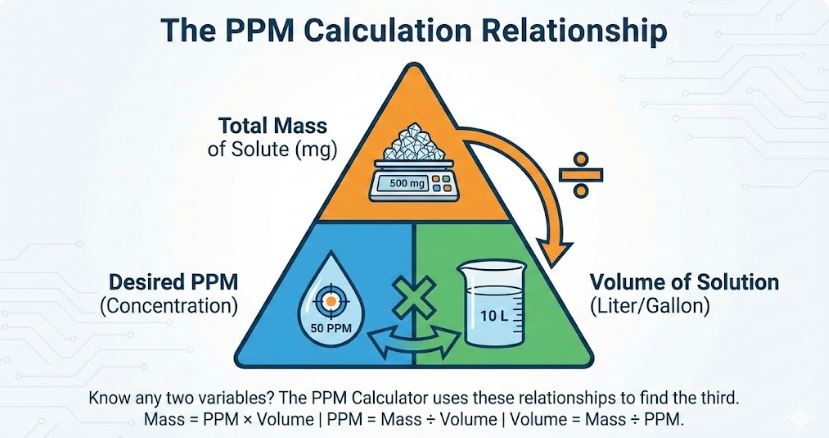
PPM is the most common way to measure the concentration of dissolved substances in water. Getting this number right is essential in many fields.
Plants require a precise amount of nutrients.
The health of your aquatic life depends on a stable water environment.
What exactly is “Parts Per Million”?
Parts Per Million is a measure of concentration. Imagine a million drops of water. If one of those drops was salt, the concentration would be 1 PPM. In liquid solutions, the mg/L (milligram per liter) definition is the easiest and most accurate way to work with it.
How does this relate to a TDS meter?
A TDS (Total Dissolved Solids) meter gives you an estimate of the total dissolved solids, which is often displayed in PPM. However, a TDS meter measures electrical conductivity (EC) and converts it to PPM using a rough factor. Our calculator is for creating a solution. You use it to add a known amount of solute to get a target PPM. You might then use a TDS meter to verify your final mix is close to the target.
This tool calculates the mass of any dry or liquid concentrate needed to achieve a PPM. It assumes the substance you are adding is 100% pure. For most fertilizers and salts, this calculation is the standard. If your concentrate is only 50% active ingredient, you would need to double the final amount.
We provide both for your convenience.