
Formaldehyde PPM Calculator
Convert mass concentration (mg/m³) to volumetric concentration (PPM).
Typical exposure limit: around 0.75 mg/m³ (TWA).
Formaldehyde PPM Conversion Calculator – Easy Chemical Safety Tool
Calculate formaldehyde levels in PPM quickly and accurately. Enter solution strength or air concentration to get exact PPM values for lab work, IAQ testing, OSHA compliance, and chemical safety.
Are you an industrial hygienist, a safety manager, or someone concerned about indoor air quality? Understanding and quantifying formaldehyde levels is crucial for ensuring a safe environment.
Our Formaldehyde PPM Calculator is a simple yet powerful tool designed to help you quickly convert raw measurement data into the industry-standard Parts Per Million (PPM) concentration, which is essential for compliance and risk assessment.
What is the Formaldehyde PPM Calculator and Why Use It?
The calculator is an invaluable resource for anyone who needs to interpret air sample data. It helps answer critical questions like:
- “How do I convert my formaldehyde concentration from mass per volume (mg/m3) to PPM?”
- “What is the PPM of formaldehyde in a room if I detected 50mg in a 100 m3 volume?”
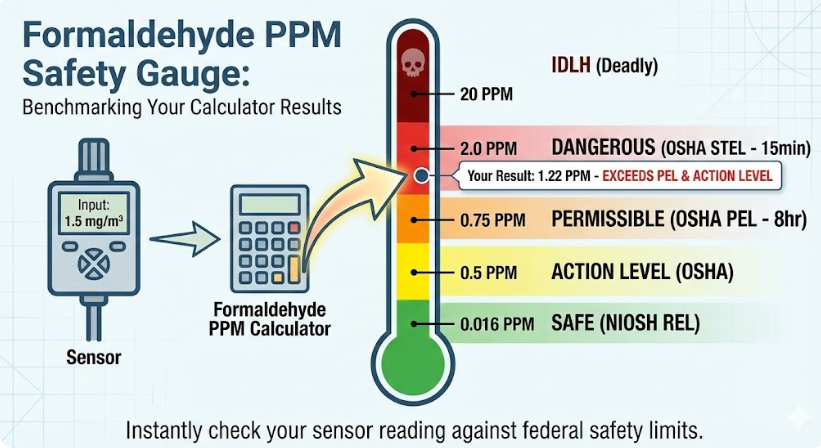
- “Is the formaldehyde level in this workspace below the OSHA limit?”
Formaldehyde (CH₂O) is a volatile organic compound (VOC) whose concentration is often measured to assess air quality. While mass per volume (mg/m3) is a common measurement unit, health and safety regulations (from bodies like OSHA and NIOSH) typically use PPM, which is a volume-to-volume ratio. This calculator bridges that gap, providing a clear, actionable number.
How to Calculate Formaldehyde PPM: The Formula
The conversion from mass concentration (mg/m3) to volume concentration (PPM) requires a specific formula that accounts for the molar mass of formaldehyde and the temperature of the air sample. The formula is based on the ideal gas law and is as follows:
PPM=Molar Massmg/m3×24.45
This simplified formula assumes standard room temperature (25°C or 77°F) and 1 atmosphere of pressure. For more precise calculations, our tool incorporates temperature into the formula. The key components you need to input are:
- Formaldehyde Mass: The total mass of formaldehyde collected in your air sample (in milligrams, mg).
- Air Volume: The volume of the air sample collected (in cubic meters, m3).
- Temperature: The temperature of the air at the time of sampling (in degrees Celsius, °C).
The molar mass of formaldehyde is approximately 30.03 g/mol. Our calculator uses this value, along with the other inputs, to provide an accurate PPM concentration.
You can verify accurate concentration levels with ppm calculations
Why is Accurate Measurement So Important?
The health effects of formaldehyde exposure can range from mild irritations to long-term health risks. Accurate measurement and calculation are not just for compliance; they are a critical step in protecting human health.
- Workplace Safety: OSHA’s Permissible Exposure Limit (PEL) for formaldehyde is 0.75 PPM as an 8-hour TWA (Time-Weighted Average). Our calculator helps you verify that your environment is safely within this limit.
- Indoor Air Quality: In residential or commercial buildings, even low levels of formaldehyde can cause respiratory issues. A precise PPM value allows you to assess risk and take corrective action, such as improving ventilation.
Using a trusted tool like our Formaldehyde PPM Calculator empowers you to make data-backed decisions about air safety, ensuring a healthier and more compliant environment for everyone.